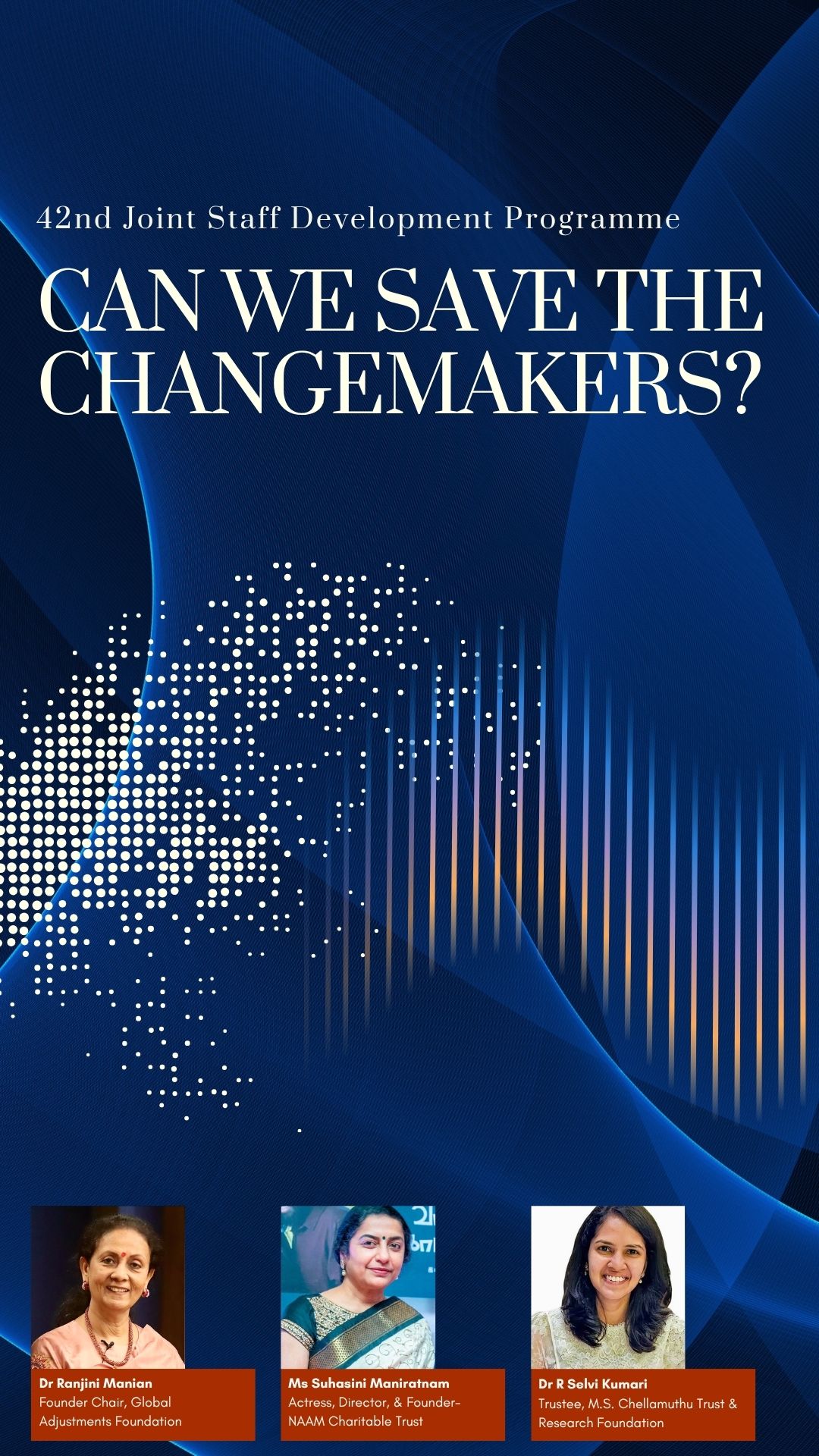
What does it take to redefine success and support within organizations to create an environment where employees feel valued and empowered?
How misguided are we in dividing our lives into work and leisure!

Four years ago, I began practicing intermittent fasting, and it has transformed my life. This practice offers numerous benefits. Regarding student well-being, I am grateful to our IIT Director, Professor Kamakoti, and the previous directors for enabling the initiation of several programs. Currently, we offer about 15 curricular courses on happiness and well-being. I would like to share some anecdotes that have shaped my life lessons, all of which are based on personal experiences. I have authored a couple of books reflecting on these experiences.
The first anecdote I’d like to share involves our staff tennis club at IIT. I have been playing tennis every day, without fail, for the past 25 years—except when it rains. This story, however, dates back more than 20 years. One day, I arrived at the tennis club a bit early, as usual, to play. Soon after, Professor Philip, a senior faculty member at the time and nearly 20 years my senior, also arrived. He was a warm and jovial person, well-liked by everyone. That day, however, he seemed unusually pensive, a stark contrast to his usual cheerful temperament.
Do not Postpone Happiness
As we both waited for others to join for our regular foursome game, I noticed his mood and decided to strike up a conversation. I casually asked, “How is it going?” He looked at me deeply—something I wasn’t used to seeing from him. He asked, “Shiva, how old are you?” After I told him my age, he gave me a look I’ll never forget. Then, with a tone of quiet introspection, he said something that has stayed with me for over 20 years:
“Shiva, I’ve worked hard all my life and accumulated wealth, thinking that one day my family and I would enjoy it. I dreamed of travelling to different places and having wonderful experiences. But now, at this age, I no longer have the energy to make such trips. The money I’ve earned doesn’t seem to hold much value anymore. So, let me give you some advice: don’t postpone your happiness while slogging away at work. Find a balance between the two.” His words struck a chord with me, and I’ve carried them ever since, doing my best to follow his advice in my daily life. Professor Philip is no longer with us, but his wisdom and kindness left an indelible mark on me.
Work is Fun
Let me move on to the second anecdote. It involves one of my professors during my master’s program at IIT Madras. After completing my B.Tech, I decided not to go abroad and instead pursue my master’s in India. IIT Madras was the obvious choice, and I had the privilege of working with a professor who had also been my thesis advisor during my B.Tech.
He was deeply engaged in several projects, and working with him gave me invaluable opportunities to learn—not just academically, but also about professional and personal values. What struck me the most about him was his work ethic. Regardless of whether it was a weekend, a holiday, or late in the evening, he was always in his office, immersed in work.
One day, during a project-related trip (I’m a civil engineer, by the way), I mustered the courage to ask him a question that had been on my mind for some time. I said, “Sir, shouldn’t you take a break and enjoy yourself? I see you working all the time.” He paused and asked me, “What do you think I’m missing by not taking a break or a vacation?”
I replied, “You’re missing a lot of fun, sir! Travelling, enjoying different places and relaxing during holiday are all part of the fun!” With a smile, he responded, “Shiva, in that case, every day is a holiday for me because I’m having fun at work.”
That statement was a revelation for me. It challenged the way I had always thought about work and fun as being two separate things. It made me realise how misguided we are in dividing our lives into work and leisure; weekdays and holidays, as if they must be mutually exclusive. His words created a powerful paradigm shift in my life. To this day, I follow his philosophy and find joy in my work. Being with students, for instance, is one of the most rewarding experiences
Letting Go
Let me share the third anecdote. After returning from Calicut, I found myself at the peak of my career with the largest number of research scholars working with me. However, I realised I had become arrogant and greedy, seeking fame and recognition with little empathy for others. This self-awareness troubled me.
Around this time, I visited BHU in Varanasi for a thesis evaluation. I thought about the custom of leaving behind something cherished in Kashi. I realised that I was clinging to my pursuit of fame and awards. At the Kashi Vishwanath temple—though I am religious—I resolved to let go of this obsession. It took six months of internal struggle, but I discovered a newfound freedom in relinquishing these desires. This period became a golden time for me, where I realised we are the architects of our own lives.
Since then, I’ve committed to listening deeply to others. Over the years, I’ve listened to around 1,600 students and colleagues, many in tears, sharing their struggles. This inspired me to start a listening club with 100 members, where we focus on understanding others—because the world needs more listening, not just talking.
My mission is twofold: to eliminate exams entirely and to inspire at least a billion people to be happy. At IIT, we offer a course called Happiness, Habits, and Success, which has over 1,000 students enrolling each semester.
I do not measure success by society’s standards but by my own boundaries and priorities.

Let me share the learnings from my experiences, my interactions with people, and the journey I have humbly travelled. I have spent more than two decades in the organisation and learnt many lessons from the ecosystem I have created. I am a passionate people person, a working parent, and the sibling of two sisters born to parents who had six children, of whom three survived. All the girls survived, while three boys passed away at a very young age.
I am a lifelong learner and a fitness enthusiast. I travel, trek, weightlift, and run as well. I deeply believe in spirituality and science, especially Hindu mythology. I cannot compromise on food, filter coffee, or sleep. I ensure I sleep a minimum of six to seven hours daily.
Chop, Chop, Chop
In all my roles, I negotiate upfront with whoever is inducting me that I am unavailable from 10:30 a.m. to 4:00 p.m., but I am available post 4:00 p.m. For instance, when I took up my role servicing America from offshore, I clearly told my boss, who is both a unit and business head: “I know America works during my night, but I will not be available at night. You can drop the work for me, and before you wake up, the task will be completed.” I hate clutter. The kitchen is my space to vent all my anger. Whatever happens at the office, I take it out on the chopping board—chopping and chopping. I also cook with a lot of love. I am fairly organised and planned, though most of my planning happens in my head and not on paper, even though I try my best to document it.
I make time for family, friends, and myself because this is important to me. I have spent 20 years with TCS, and both the organisation and nature have been kind to me. I started as a lateral EP Lead and moved on. In 2004, during TCS’s growth stage, I led recruitment initiatives and later took on several Unit HR roles. I have also handled corporate roles. I went overseas as a single parent with my five-and-a-half-year-old son, gaining invaluable personal and professional learning experiences. After returning, I had the opportunity to work at corporate, charting the DEI strategy, leadership strategies, and more. Today, I handle the largest branch, which allows me to interact with many people. What has worked for me may not work for everyone because the environment and context can be entirely different.
My Learnings:
Define priorities and set boundaries: Each of us need not measure success by what others have achieved. It’s my story, my journey, and so I define what matters most—whether it’s professional growth, family, health, or a passion project. I have even stepped back in my career to prioritise my family. Recently, I took five months off to be present while my son prepared for his Standard 12 exams. I do not measure success by society’s standards but by my own boundaries and priorities.
Integrate, don’t separate: We juggle various roles, trying to balance them. It’s about trading one for another, like trading work for life, but integration makes it easier. Technology allows for much of this integration, and COVID accelerated this process. Define your passion and purpose. Ask yourself: What is your Ikigai? What gives you energy and a sense of fulfillment? As an HR professional and parent, I’ve found meaning in blending work opportunities and personal interests. Either make work fun or make fun work.
Practise flexibility: Every day is not a bed of roses. There have been ups and downs. Life changes, work changes, and so do our priorities. Adjust and adapt. As a long-distance runner covering 21 or 42 kilometres, there are moments to slow down. Don’t worry about others running faster. Slowing down sometimes helps you reserve energy to complete your race. What’s important is staying on course.
Delegate and ask for help: Invest in relationships at work and home. Asking for help, delegating tasks, and outsourcing are signs of strength, not weakness.
Take care of yourself: I don’t wait for a knight in shining armour to save me in difficult situations—I am my own knight. It’s okay not to be okay. Be kind to yourself and think that ‘this too shall pass.’
Everything is a choice—your goals, priorities, attitude, opportunities, and style. However, while you are free to make choices, you are not free from their consequences. Own your decisions and the outcomes. You cannot have your cake and eat it too. Look for possibilities. Whenever I’m given an opportunity, I ask myself what I can make of it. Accept challenges and take calculated risks.
Stay curious and keep learning: Over the last 22 years, I have ensured I learn one new skill each year, whether it’s design thinking, agile methodology, driving, swimming, baking, or putting kolams. Learning happens when you step outside your comfort zone. Surround yourself with positive, caring people.
Prioritise self-care: Many women aspire to be super moms, super wives, super friends, super daughters, and super bosses. Perfection is a myth. Sometimes, you just need to let go. When you earn a place at the table, sit there—not on the sidelines. My success stems from my self-worth.
Make time for exercise, relaxation, and activities that recharge you. I’ve learned from Japanese methodologies. For example, Kanban helps me track tasks, and the Pomodoro Technique keeps me focused—25 minutes of work followed by a 5-minute recharge.
Embrace imperfection: Kaizen teaches us the value of small, incremental changes. Wabi-sabi reminds us to accept flaws and imperfections. Don’t wait for the perfect moment; start and improve as you go.
Maintain discipline: Diet and nutrition matter greatly. I eat until 80% full and maintain a disciplined schedule—waking at 4 a.m. and finishing dinner by 7 p.m.
Find your Everest: Everyone has their Everest to conquer. For me, this involves setting clear goals—how much I want to work, when I want to retire, and how I plan my year. Life is unpredictable, but staying aware, relevant, and focused on strengths while addressing weaknesses is key. Build alternate skills for future income generation. Happiness lies in small moments. Journal your good days, as we often remember the bad more vividly. Play to win at life, not battles. Keep smiling—and keep listening.
How to restore the balance?

We are currently in a critical period where people are facing numerous health challenges, both physical and mental. The mortality rate among young individuals is alarmingly high. We are witnessing an increase in mental breakdowns among young people and even children being affected.
What is work-life balance? It involves making decisions to set boundaries at work while engaging in a satisfying personal life. I see many successful people who are completely disconnected from their personal lives. The impatient ones file for divorce, while the more patient ones seek psychotherapy. Their physical health parameters may be normal, but they simply don’t have the time.
Heaven becomes Hell
Before marriage, when couples come to invite us, they often say, “My groom is very successful. He travels to at least two countries a month and earns a high salary.” They are very happy, and the entire family is excited. However, after just three months of marriage, they come back feeling very depressed. Why? They say, “He doesn’t have time. He rarely talks to me. Most of the time, he is abroad.” What initially seemed like an advantage, in reality, becomes a significant disadvantage.
In the past, households often included elders, but now we don’t share our homes with them. As a result, children are increasingly isolated. Anyone who comes home often has no one to talk to. While Prof Sivakumar spoke about the importance of listening, I would emphasize the importance of talking. As a psychotherapist, I encourage people to talk. If you don’t talk, you will face serious problems. Without someone to talk to—or even to listen to you because you haven’t listened to anyone—you are bound to experience loneliness.
Thankfully, many people are doing well, and we are happy about that. However, there are also those who are highly stressed, and some hit the burnout stage very quickly. In extreme cases, we even see death. There is a clear pattern; it is a spectrum.
Some people excel, moving from one job to another for a higher salary, or even relocating abroad. On the other hand, there are those who struggle due to a gap between their abilities and the performance expected of them. That’s where the problem begins. Many people slog through their jobs because they lack the necessary skills. Fortunately, there are now many courses available to help people upgrade their skills. However, if a person fails to enhance their skills, they may be unable to meet expectations and will eventually be filtered out of the system.
Living in Fear
This creates a constant sense of fear. Anyone working in the private sector lives under the threat of budget cuts. When budgets are cut significantly, higher-level employees may lose their jobs. For smaller cuts, lower-level employees are affected. This perpetual state of insecurity keeps everyone on edge, forcing them to perform at their best. If you are not at your best, your days in the company are numbered.
So, you either cope—or you don’t. Some cope by being highly stressed, while others reach a stage of burnout, needing intervention from doctors, psychotherapists, or psychiatrists just to function again.
Mental health problems are significantly on the rise. People experience frequent mood fluctuations, irritability, and low frustration tolerance. On the roads, you witness road rage, with individuals screaming at one another—these are clear signs of a mental health breakdown within the community. In Western countries, they advise, “Even if you haven’t made a mistake, just say sorry and move on.”
Respect the Second Brain
Cardiovascular issues are also becoming more prevalent. We hear about young people experiencing heart attacks and significant fluctuations in blood pressure, which can lead to a host of related problems, including strokes. Sleep and appetite have become major casualties of modern life. Many of my patients schedule online video calls with me as late as 2 a.m. or 3 a.m., making payments at those hours. Why? Because they’re still working. They pause for a session, then return to work late into the night.
This lifestyle takes a severe toll on the digestive system, which is often referred to as the “second brain.” If you’re not eating well, not digesting food properly, or failing to maintain a regular eating schedule, it affects your mood and leads to various other mental health issues.
Hormonal health is significantly impacted by modern lifestyles. Women are among the worst affected, but men are not spared either—issues like impotence are becoming alarmingly common at a young age. Sexual health, overall, takes a substantial hit.
Follow Circadian Rhythm
Some people advocate for working 70 hours a week, but in developed countries, the norm is a five-day workweek. Even doctors typically avoid taking calls on weekends unless it’s an emergency, which is handled by duty doctors. In contrast, Indian doctors are often favoured because they are always accessible, willing to take calls and provide advice at any hour.
This raises the question: What are we trying to catch up with? I vehemently oppose this unsustainable work culture because it ruins lives. The consequences of these practices will likely haunt us for the next 100 years. We must acknowledge the gravity of this situation and oppose ideologies that go against nature. Humans are not meant to work 14 to 18 hours a day. Our bodies are simply not designed for that.
Our circadian rhythm is a natural system we must respect. The body functions in specific ways, and there are no shortcuts around it. Ignoring this balance will inevitably result in dire consequences—it’s as logical and straightforward as one plus one equalling two. Nature does not accept modifications.
At specific times, we are naturally alert, and at others, our mind begins to shut down. Melatonin secretion kicks in as the sun sets, signalling the need for sleep, and we wake up with the sunrise. Now, imagine someone continuously working through this natural cycle. One individual shared with me that he used to sit in his office for days, watching people come and go, while he just kept working. That lifestyle eventually took a toll, and he is now under my care.
Constant stress or even the threat of losing a job creates a negative mental loop. The mind, when perpetually under fear—whether fear of losing a job, status, or possessions—forms a persistent negative feedback cycle. Speak to anyone who is retired. Many of them, even after 20 years, strongly associate themselves with their former jobs because their identity is tied to that work. Letting go of it is far from easy.
Living in constant fear activates the amygdala, the brain’s stress-response centre. Over time, this leads to overreacting to even minor stressors. This is why many people perpetually complain—they begin to see the world as a source of problems rather than challenges.
Stress and Identity: The prefrontal cortex, essential for emotional health and decision-making, suffers under prolonged stress. Poor decisions often follow, compounding problems. Neurotransmitter imbalances—such as low serotonin—lead to mood swings and depression, while dopamine deficiency diminishes the ability to feel pleasure. Overactivation of the hypothalamic-pituitary-adrenal (HPA) axis increases cortisol levels, further exacerbating stress-related issues.
The Imbalance of Ambition and Reality: Many aspire to fast-track their careers—becoming VPs or CFOs as quickly as possible—without regard for their limitations. While ambition is healthy, it becomes toxic when one’s talents or resources fail to meet the demands. Unrealistic corporate goals often force employees to take on additional responsibilities, stretching them to their breaking point.
Despite the proliferation of financial management consultants, financial mismanagement remains a significant issue. Early in my career, I was fortunate to receive professional guidance and mentoring, which emphasised the importance of sound advice in navigating challenges.
Workplace Relationships: Workplace dynamics also pose challenges. Office politics can be toxic, while overly familiar relationships sometimes cross boundaries, leading to inappropriate affairs. Many individuals use work as an escape from unhappy marriages or poor personal lives. It’s not uncommon for people to sit in their cars or parking lots, dreading the thought of going home. Social media reels provide an endless distraction, allowing them to avoid facing reality until exhaustion sets in.
How do we restore balance?
Adopt a Healthy Lifestyle: Say no to addictions. Understand your skills and take on responsibilities that align with them. Avoid overworking yourself into a health crisis that leads to costly medical bills or long-term disability.
Think Long-Term: Avoid rushing through life. Focus on sustainable growth. Build meaningful relationships by investing time, money, and energy.
Prioritise Health: Never compromise your physical health. It is non-negotiable.
Avoid Exploitation and Politics: Don’t let others exploit your vulnerabilities. If people know you’re desperate, they may overburden you with work for minimal incentives. Stay away from office politics, which can ruin both productivity and peace of mind.
Communicate: Talk to as many people as possible. Open communication can ease stress and build stronger networks.