“In India, inflation is largely supply-driven.”
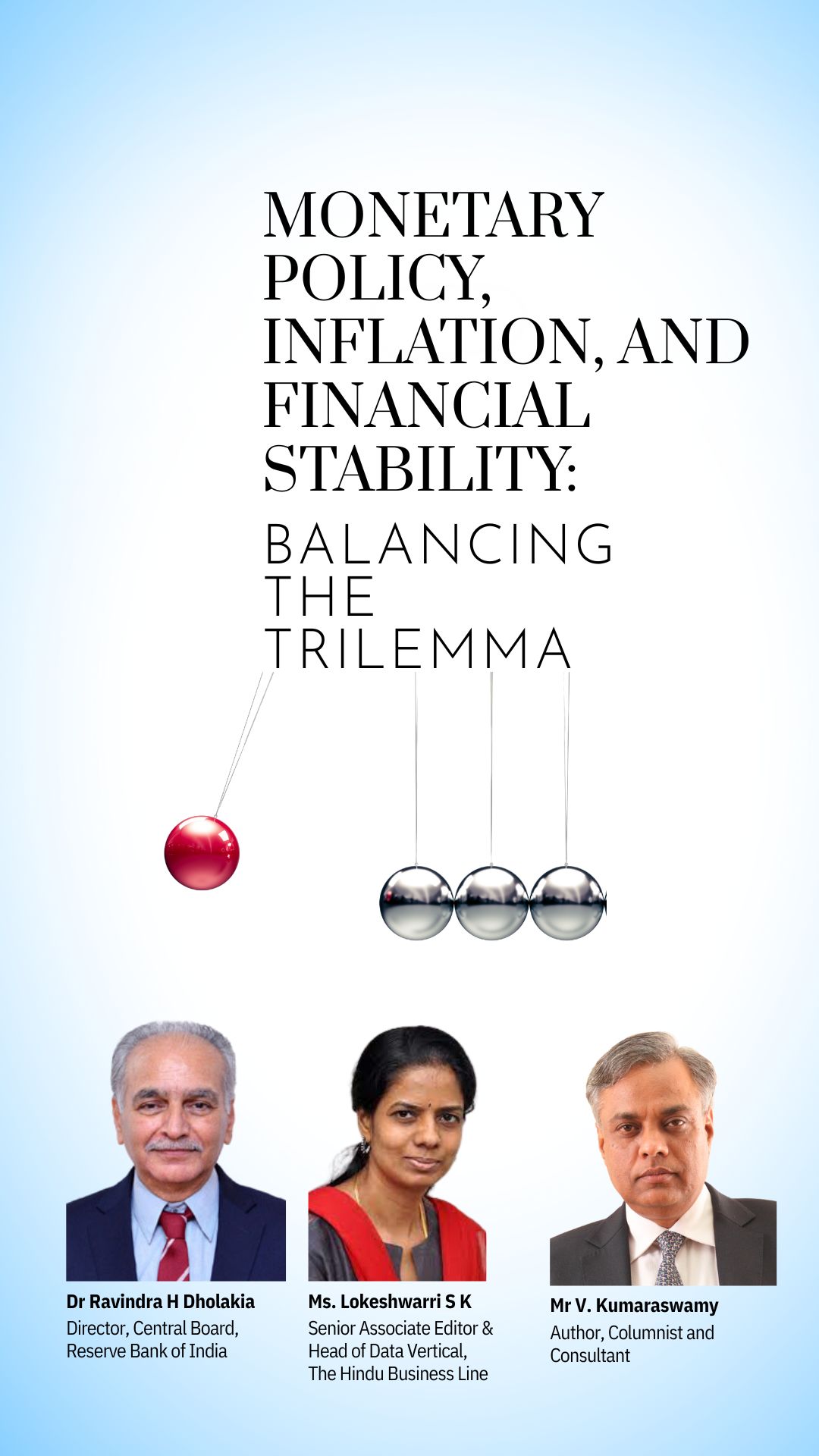
Excerpts from a panel discussion that examines how monetary policy interventions aimed at containing inflation can at times conflict with the goals of financial stability and economic growth, particularly in an economy undergoing rapid structural transformation.

Dr Ravindra H. Dholakia
Director, Central Board, Reserve Bank of India
I am delighted to address this highly engaged audience on a theme that sits at the heart of modern macroeconomic governance—monetary policy, inflation, and financial stability. The phrase “balancing the trilemma” is not merely a catchy description; it represents a structural limitation embedded in an open economy framework. In theory, the trilemma emerges when you simultaneously pursue a fixed exchange rate, capital account convertibility, and an independent monetary policy. A Nobel Laureate demonstrated that these three cannot coexist fully; something has to give. Now, I’m not suggesting we are “solving” the trilemma—we live inside it. We face it continuously, and that is why policy cannot be simplistic or copied wholesale from elsewhere.
My first point is that monetary policy frameworks widely adopted today originate from the experience and structure of advanced economies. But advanced economies are fundamentally different from India. A developed economy is relatively stagnant in structural terms: urbanisation is near complete, employment composition is relatively stable, and real growth rates tend to hover around 1–2%. Inflation targets are often anchored near 2%. This environment produces its own logic and policy architecture. India is not that economy. India is dynamic. Urbanisation is accelerating; structural transformation is ongoing; technological progress is substantial; and real growth expectations are meaningfully higher, even under challenging global conditions. When we operate in a fundamentally different economy, we cannot uncritically adopt frameworks designed for economies with fundamentally different parameters.
Let me outline the core premises behind the dominant monetary policy framework. The first premise is that inflation is primarily demand-driven. If inflation is supply-driven, monetary policy has limited traction. The second premise is that inflation is largely a monetary phenomenon—control liquidity and money supply, and you can control inflation. The third premise is that money is neutral in the long run, implying that monetary policy does not affect real variables over time; it only affects the price level. This is why inflation targeting regimes gained popularity: they build on these assumptions to argue that controlling inflation is central and costless in the long run. But I have serious concerns about whether these assumptions hold for India without adjustment.
My concern is that in India, inflation is largely supply-driven. That changes the role monetary policy can play. If inflation is supply-driven, then interest rate adjustments alone cannot solve the problem; what matters much more are the growth process, logistics efficiency, productivity expansion, agricultural supply chains, and structural reforms. When growth is high and supply responds effectively, inflation pressures can be moderated. When growth is slow and supply constraints dominate, inflation can remain stubborn even when demand is not overheating. That is why I do not believe inflation in India is demand-driven in the same way it is in many advanced economies.
The second concern is that money is not neutral in the long run. I know that sounds heretical to many economists who grew up on classic monetary theory. But we must reconcile monetary theory with growth theory. In growth theory, investment has a capacity-creating role; in many monetary frameworks, investment is treated merely as an element of demand. That disconnect matters. In the real world, money and finance affect capital formation, productivity, and long-term growth outcomes. In a developing economy, to treat long-run money neutrality as a practical truth is risky. Policy is not performed in textbooks; it is performed on the ground.
I also emphasise the idea of a threshold level of inflation. If money is not neutral, the relationship between inflation and growth is not linear. There exists an inflation level that maximises growth. Below that threshold, growth suffers; above it, growth suffers. My research shows that this threshold depends on fiscal deficit and the current account deficit. Therefore, there is no single universal inflation target that is always optimal. Inflation targets must be consistent with the broader macro framework, not set independently as if the economy is modular.
Which brings me to what I call the “quadrilemma.” We talk about the trilemma—exchange rate stability, capital mobility, and monetary policy independence. But India is also living with explicit or implicit targets for growth, fiscal deficit, and current account deficit. We have aspirational targets: 8–8.5% growth is regularly discussed in the context of developed India. We have an inflation target of 4% with ±2% tolerance. We have fiscal deficit targets under FRBM frameworks and a prudential view that CAD should remain around 2–2.5%. These four variables are interdependent. “Only three of them can be decided independently—the fourth automatically gets decided.” If we set all four targets independently and inconsistently, macro stability breaks down, and financial stability cannot be guaranteed.
Financial stability is not separate from macro stability—it is part of it. If savings and investment do not reconcile, if income and employment expectations do not align, then exchange rate instability becomes inevitable. In that sense, the obsession with treating exchange rate movements only as a financial market phenomenon is incomplete. It reflects deeper macro disequilibria and expectation dynamics.
Finally, I want to raise a very serious issue: measurement. Our inflation measurement is not satisfactory. We measure inflation using weights derived from household expenditure surveys, while growth is measured using GDP-based weights. These weights do not reconcile. To give a stark illustration: inflation measurement assigns around 46% weight to food, while GDP assigns only around 16%. These numbers cannot simultaneously be correct representations of the same economy. Either we are mis-measuring inflation or mis-measuring growth. In my view, the larger error lies in inflation measurement. Services are under-captured, consumer durables are understated, and the richest segments are not adequately represented. If we do not fix measurement, we will commit policy errors because we are making decisions on flawed inputs. I have said openly that unless measurement improves, “we are going to commit blunders while taking decisions because the basis on which we take decisions are wrong.” If we want monetary policy that is meaningful, inflation control that is credible, and financial stability that is sustainable, we must first ensure that we are measuring the economy correctly.
“A single CPI number cannot capture the lived experience of inflation.”

Ms Lokeshwarri S. K
Senior Associate Editor & Head of Data Vertical, The Hindu Business Line
When we talk about monetary policy, inflation, and financial stability, it becomes clear very quickly that the problem is not just theory—it is communication, public expectations, and how we interpret the data that arrives into the policy system. I often see the public conversation collapsing into one headline: “inflation is under control” or “the central bank is behind the curve.” But the real challenge is always the interaction between objectives. Most central banks today prioritise price stability, and in many cases, the credibility of inflation targeting has helped anchor expectations. But the question is whether a framework designed with one set of structural assumptions can be applied without adaptation to an economy that is structurally transforming.
Flexible inflation targeting in India, introduced in 2016–17, is often credited with lowering volatility and improving inflation discipline. And from a market perspective, a stable and predictable inflation regime does help. But I also see the argument that a narrow inflation target might be inconsistent with the growth aspiration of an economy like India. That is not a trivial point. If a country aims for sustained high growth and structural upgrading, it must examine what inflation range supports investment, employment creation, and productivity growth. The key question is not whether inflation targeting is “good” or “bad.” The real question is: how do we design the inflation target and the tolerance band in a way that is aligned with India’s growth potential, fiscal priorities, and external stability?
Another important reality is that inflation is experienced differently across people, regions, and professions. A single CPI number cannot capture the lived experience of inflation. In some households, food inflation dominates. In other households, services inflation dominates. In some cases, rent, education, and healthcare inflation become far more relevant than cereals or cooking oil. So when the public says “inflation is high,” they are often describing their personal inflation basket. That makes it difficult for a single policy rate to feel adequate to everyone. It also raises the need for better communication and better public understanding—what central banks call expectations management.
I also strongly believe that responsible financial journalism has a major role to play here. Monetary policy can become complex and technical. But the public needs to understand what the policy is attempting to do, what trade-offs it is managing, and what limitations it faces. My view is that it is up to the media to simplify the analysis without oversimplifying the truth. That is a hard balance, but it is essential. And it cannot be done just through long reports and expert panels. Central banks and institutions must invest in explainers, interactive tools, and regional-language communication so that the public can build economic literacy. I have suggested that it would help if the RBI itself put out accessible explainers, perhaps short videos, and even training modules for media professionals. A system becomes stable not only through policy rules, but through shared understanding. When inflation targeting is credible, it is partly because people understand and believe what the central bank is doing, not just because the repo rate is adjusted.
I also think market behaviour is too often driven by selective narratives, global headlines, and short-term fear cycles. We see this in exchange rate movements, in bond yields reacting to global events, and in markets over-reading every foreign policy development. That is why communication becomes inseparable from stability. If markets react to panic, the job of the journalist is not to amplify panic, but to contextualise it. That is why I value data journalism—because it forces us to locate the story inside numbers, trends, historical ranges, and comparable experiences, instead of living inside speculation.
In the end, what I want our readers and audience to take away is this: monetary policy is not a single-variable game. It is a balancing act, and it becomes even more complex in a fast-growing economy with supply constraints, uneven inflation experiences, and evolving data systems. Good journalism has to help the public understand that complexity without losing clarity.
“Time to recognise the reality of fragmented inflation.”

Mr V. Kumaraswamy
Author, Columnist and Consultant
When we discuss inflation, monetary policy, and financial stability, the first thing I want to underline is that there is no monolithic inflation figure that works for everyone. Inflation in Madurai will not be inflation in Chennai; inflation in Agra will not be inflation in Bengaluru. And even within the same city, inflation will feel very different depending on who you are. This is not merely an academic point—it goes to the core of how households actually experience stress and how policy choices create winners and losers.
Let me give you a simple example from my own life to show how fragmented inflation really is. As a pensioner, I have a roof over my head, so housing inflation does not affect me in the way it affects someone who is renting or buying their first home. I have stopped commuting daily to work, so fuel inflation does not hit me the way it hits a working professional. Food consumption is governed not by aspiration but by diet—if a restaurant offers a second or third roti, I run away from the table. So what is the inflation that impacts me? Medical inflation. That is the only part of the inflation basket that genuinely makes me anxious over time. Now imagine the opposite—a young person building a career, paying rent, commuting, repaying a loan, supporting family. Their inflation experience is entirely different. This is why policy debates that treat CPI inflation as one national lived reality often miss the practical truth.
This also means that the politics and social response to inflation cannot be understood purely through a central bank lens. People respond to what they face daily. If groceries, rent, transport, and school fees rise together, households feel squeezed even if headline CPI is within a band. If the RBI claims inflation is under control but households feel their personal inflation is not, credibility suffers. So a key underestimated factor in inflation and household financial stress is how fragmented inflation experience really is—and how policy communication sometimes fails to recognise that fragmentation.
I also believe that we are living in “interesting times,” and the global environment has amplified domestic complexity. We have had Covid shocks, wars, commodity volatility, and global interest rate cycles that are far from predictable. Add to that the fragile confidence cycles of markets. I often wonder whether market participants are discounting real fundamentals or simply reacting to today’s narrative. In a world where you can switch on television and see constant fixation on what the U.S. leadership might do next, panic becomes a tradable commodity. That is not a healthy foundation for financial stability.
Which is why I appreciate frameworks that treat stability not as a one-variable equation but as a system. I find the idea of synchronising growth, inflation, fiscal deficit, and current account deficit extremely important. If you do not align them, you destabilise the system. The danger is not that we debate the ideal policy; the danger is that we measure wrong, interpret wrong, and then act confidently on flawed assumptions. Once that happens, we are not managing an economy—we are managing apparitions.
I also want to point out that the discussion around exchange rates and external flows often misses a deeper reality: financial stability is not just about what the RBI does. It is also about how the economy grows, how exports compete, how imports are managed, and how confidence is built in long-term investments. Short-term portfolio flows are fair-weather friends. But long-term investors—FDI—are the ones who build factories, supply chains, and jobs. If the environment is stable, predictable, and growth-oriented, real investors come. If it is not, they wait or divert.
Ultimately, my point is simple: we cannot treat monetary policy as a closed technical debate among economists. It is a lived system that affects very different people in very different ways. If we want stability, we have to respect that fragmentation, improve measurement, strengthen communication, and keep the focus on what matters most in a developing economy—growth that creates jobs and expands supply capacity.