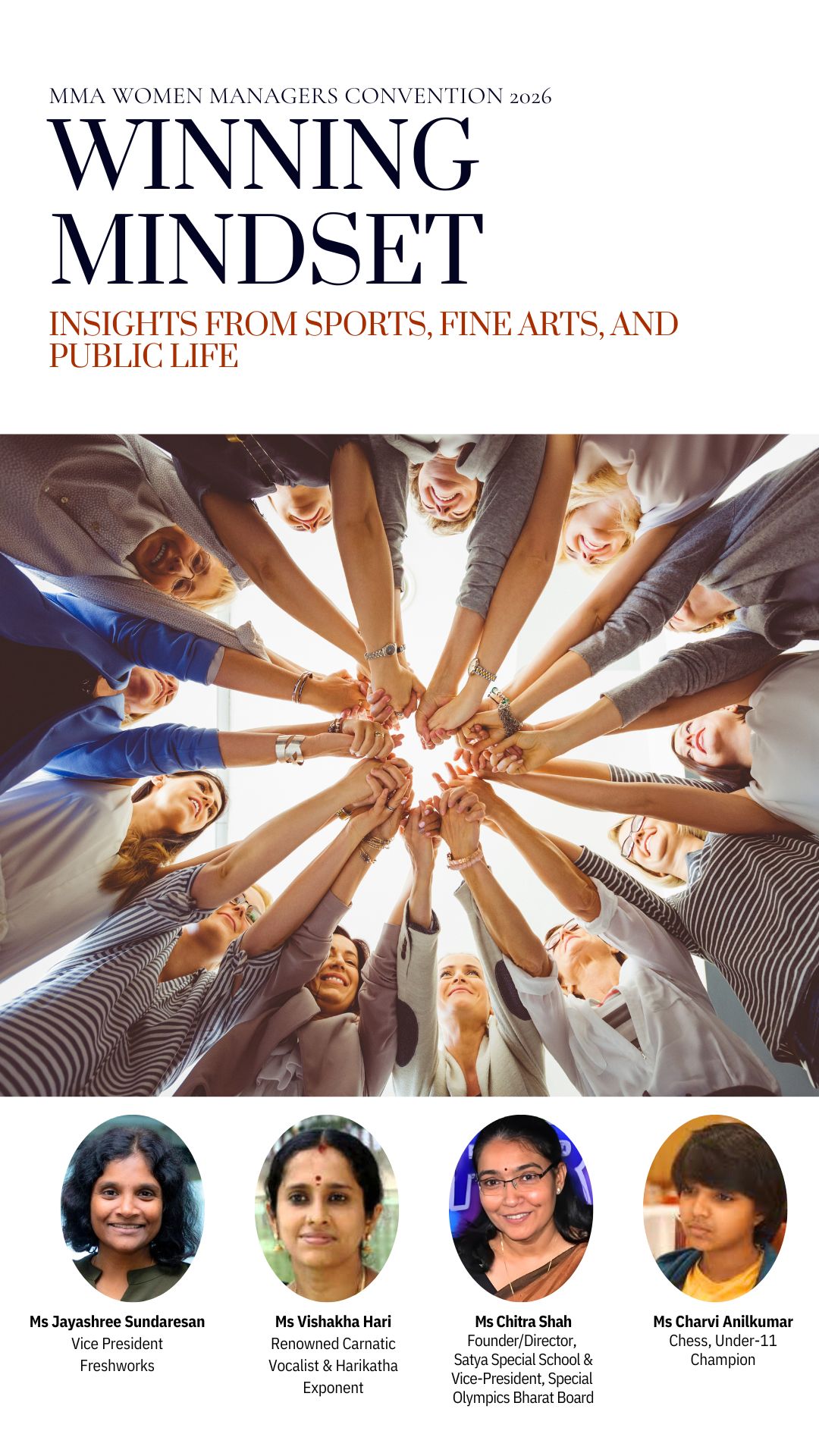
Ms Jayashree Sundaresan | Vice President, Freshworks | Moderator
Ms Vishakha Hari | Renowned Carnatic Vocalist & Harikatha Exponent
Ms Charvi Anilkumar | Chess Under-11 World Champion
Ms Chitra Shah | Founder/Director, Satya Special School; Area Director & Vice-President, Special Olympics Bharat
Leaders across domains unpack the mindset behind winning, where consistency, courage, and compassion matter more than outcomes and recognition.

Ms Jayashree Sundaresan
When we hear the word ‘winning,’ most of us think about trophies, medals, awards, and applause. But if you talk to a sports person, a musician, or a social reformer, they will tell you it is rarely about only the final moment. It is thousands of unseen moments that truly lead up to it — the early morning practice when nobody is watching, the tremble in your voice that you overcome when you step on stage, the quiet patience needed when change is painfully slow.
Personally, I think about this often. There is a term for it: transferable skills. I lead engineering teams professionally, but I am also deeply connected to sports, to singing and dancing, and to creating positive impact around me. What I have realised over the years is that what helps you win on a badminton court is the same mindset that helps you deliver a project successfully. The discipline needed to perform on stage is the same discipline that helps you deliver a killer presentation. The resilience required to pursue a social cause mirrors the resilience needed to create organisational impact.

Ms Vishakha Hari
Let me ask you this directly: what does winning mean to you? For some people it is name and fame. For others it is wealth. For some, success is simply living a peaceful life or having a good family. Success means something different for every person — and recognising that is the first step to an honest relationship with it. According to our ancient Indian wisdom, true success is that fulfilling moment when you say: I feel blessed. I feel complete. When a professor watches his student answer questions on stage, that is his winning moment. When an autistic child who could not speak for twenty years suddenly says ‘amma,’ that is a winning moment for an entire family. Winning is not about laurels, trophies, grades or ranks. It is that moment of fulfilment.
On the question of discipline and sadhana — there is no shortcut. Everyone today, especially the younger generation, wants instant success the way we want instant coffee. But the only route is through sustained practice. Let me tell you about my guru, the violin maestro Sri Lalgudi Jayaraman. He had performed on thousands of stages, won national and international awards, and then suffered a severe stroke. Most of his fingers failed him. Most people in their fifties would say their career is done — but not someone with a true calling. He began his sadhana from scratch, using the fingers that remained, practicing four and five hours a day after his illness. Soon he was performing again. Behind what looked like magic was willpower and practice. Sadhana doesn’t end at a certain age or after a certain number of achievements — it continues precisely because you love what you do.
When things go wrong on stage, the answer is surrender — not giving up, but releasing into the art and the tradition. At a packed concert that started an hour late, I walked on at 8:30 to a restless audience with all the microphones malfunctioning. I could not hear myself, the instruments were unbalanced, and the monitors were silent. In that moment I simply surrendered to my Ista devata, to the art form and to my gurus, and began with a simple devotional song — inviting the audience to sing along. For twenty minutes, while the sound engineer worked quietly in the background to fix everything, the audience sang, danced and clapped. Afterwards, they told me the first twenty minutes were the best part of the concert. What you cannot control, you offer. That offering always returns something.
On storytelling: Valmiki, Vyasa and our great Rishis were far-sighted beyond measure. In the Ayodhya Kanda of the Ramayana, there is a section called Kachchit Sarga — a hundred questions that Rama poses to Bharata on the subject of management alone. It covers staffing, delegation, planning, deadlines, bonuses, work-life balance, health and sleep. Present that text authentically before any leadership audience and a dozen leaders will walk away transformed the next morning. I did not choose Harikatha. Harikatha chose me — just as Lalgudi Jayaraman once said the violin chose him.

Ms Charvi Anilkumar
When I am deciding my next move in a match, I first evaluate the position — king safety, pawn structure, control of key squares. Based on that evaluation, I identify a few candidate moves, then calculate several moves ahead while anticipating my opponent’s best responses. I check for tactical possibilities, trust my intuition from patterns I have trained on, and finally do a quick blunder check before committing. My goal is always to choose the move that improves my position while making my opponent’s plan more difficult. I think this process translates directly to any field: identify the problem, explore possible solutions, anticipate the other side, and choose the best available path.
Composure is partly natural, but most of it comes from practice and accumulated experience. Playing many games across many kinds of pressure situations trains you to stay calm and focus on the position rather than on the pressure itself. When you stay calm and focused, you can find the best move even from the worst position. I used to feel very bad when I lost. Now when I lose, I try to understand my mistake and learn from experienced players. I either win or learn — there is no other outcome. To stay centred during long matches, I practise breathing exercises, meditation and yoga daily. My first victory over a grandmaster took more than six hours. I was fighting until the very last moment. And to prepare: my coach always says do not prepare for one tournament. Prepare for all competitions. Consistent preparation is everything.

Ms Chitra Shah
Before I say anything else, let me clarify a distinction that matters enormously. Paralympics involves physical disability — what you can see. Special Olympics is the invisible disability: someone who looks exactly like you and me but carries an intellectual or developmental difference. Our work is to find the ability within that disability. I started in 2003 as a young mother and social work student wanting to spend my time usefully. Volunteering with a psychiatrist, I met a 13-year-old girl with Down syndrome who came to us with cut marks on her hands and legs. When I visited her home, I found her tied to a plastic chair with nylon ropes, locked inside for eight hours each day while her mother worked. When I asked the mother why, she said: my husband left the day he realised this was a special-needs child, my family rejected me, everyone calls me a sinner, and if I go out to work without securing her I risk her being sexually abused — as had already happened, twice, leading to pregnancies. That mother’s words are the reason I am standing here today. I wanted to build a place where mothers could safely leave their children, and where every child — ability or disability — could be happy.
From twenty children, we now reach over four thousand across Puducherry down to the tip of India at Karaikal. I believe every child, whether urban or rural, has the right to dignity, inclusion and to be heard. Working in this space cannot be a job. It has to be a passion. The graph is never consistently high — but the wins are profound. We took a basketball team to the Special Olympics World Games in Berlin, qualifying by the thinnest margin. When we arrived, the Australians walked like professionals. We had eight athletes from eight different states with eight different abilities, many of whom had come together as a team barely a month before departure. In the 400-metre final, one of our athletes — whose own village had urged her mother to abandon her — stayed within her lane, ran her own pace, and won the gold because every other runner crossed out of their track. Afterwards she came looking for me and asked: are you happy now? When she returned home, that same village invited her as the chief guest for their temple festival. The midwife in Usilampatti who refused to participate in female infanticide changed an entire district — and today the first thing you see when you enter Usilampatti is a women’s college. One person’s refusal to accept the impossible changed history.
Q&A
What personal experience reinforced your belief that social change is possible through sustained effort?
Ms Chitra Shah: As a social work student I wrote my thesis on female infanticide in Usilampatti. One midwife decided she would no longer do what she was forced to do, and let her voice be heard. That single act of refusal changed an entire region. As a young student, watching that happen made me understand: if women decide something is going to change, it will change.
What qualities define a winning mindset that helps individuals succeed consistently over time?
Ms Jayashree Sundaresan: My mother shared something with me when I was six years old that has stayed with me every day since: whether you do small things or great big things, do every small thing in a great way. I have applied that to my life whether it is the smallest of projects or the biggest decisions I face. The joy I try to draw from every moment is in doing each small thing excellently. Even if I don’t end up doing great things in life, I know I am going to be happy — and I believe that is the winning mindset that has truly carried me forward.
What made you move from being a first-rank taxation professional to a Harikatha storyteller?
Ms Vishakha Hari: Every person’s journey is divine will — though we believe we are planning and navigating it ourselves. I would say the same thing Lalgudi sir said when asked why he chose the violin: I did not choose the violin. The violin chose me. I did not choose Harikatha. Harikatha chose me.