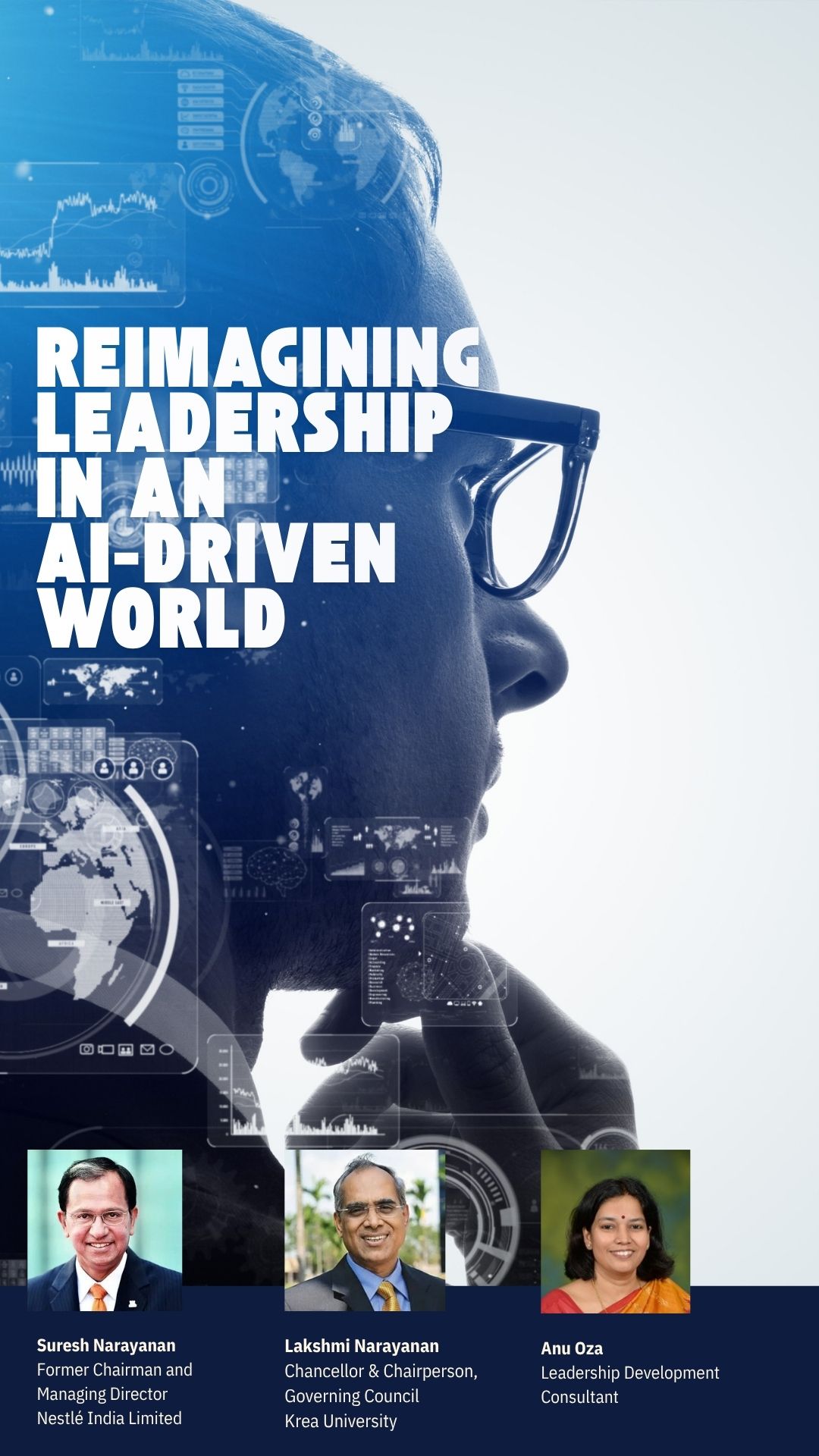
When Group Captain Vijayakumar informed me that Shri V. Balaraman had recommended me to deliver the Sixth V. Narayanan Memorial Endowment Lecture, I was deeply honoured and personally delighted, because I share three serendipitous connections with VN.
The First Connection: A Fragrance from Cuddalore
The first goes back to my early days on the morning bus from Cuddalore to Chennai. You didn’t need a signpost to know you had arrived in the city; the unmistakable fragrance of Pond’s Dream Flower Talc drifting from the factory was an alarm clock signalling: You have reached Chennai. VN had built a sensory memory and a standard of excellence that defined the landscape.
The Second Connection: IIM Ahmedabad and the Gravitational Pull of Pond’s
My second connection jumps to my time at IIM Ahmedabad. Pond’s wasn’t just a corporate recruiter; it was the dream company, the ultimate validation of your capability. VN didn’t just build consumer products; he built a gravitational pull for the brightest minds. Three of my closest friends—Kandy, Deepak, and Vaidy—joined Pond’s. Through their decades-long journeys, I had a front-row seat to the culture of excellence VN cultivated, engineering high-performance human networks long before it became a buzzword.
The Third Connection: The 4C Framework
My third connection is deeply personal. In the 1980s, while reading standard corporate AGM speeches, VN’s stood out. He referred to Pond’s as a ‘culture of character and competence’. That phrase stayed with me. Decades later, as the founding Managing Director of Saint-Gobain Glass India, I established our 4C Framework: Competence, Commitment, Credibility, and Continuous Improvement. Those four C’s are the undeniable legacy of VN.
Recently, reviewing VN’s AGM speeches in The Hindu archives, I was astonished by his foresight. In the 1980s, he was already eloquently articulating ‘stakeholder capitalism’ and corporate ‘purpose’—concepts that wouldn’t gain global mainstream traction until a full decade later. He was a visionary who constantly looked around the corner. Because of that, I am absolutely certain that if VN were standing at this podium today, he wouldn’t be looking in the rearview mirror. He would be examining the most profound shift of our era. He would have chosen to speak on Artificial Intelligence.
But AI is a vast, noisy subject. To honour his legacy of practical, continuous improvement, I am consciously staying away from classical debates tonight—whether AI is just hype, an investor bubble, or how governments should regulate it. Those are discussions for another time.
The “I” in A.I.: Why It Matters
Tonight, I want to focus entirely on the ‘I’ in A.I. And that ‘I’ is all of you. And it is me as well.
Ninety Years of Artificial Intelligence in Five Paragraphs
To answer that, we must understand what this technology actually is. For most, Artificial Intelligence was born in November 2022, dropping onto our phones as ChatGPT. It is easy to view this as a sudden tech trend. But the truth is, this is exactly a 90-year journey of science. As I was preparing this, my family gave me a strict warning: ‘Do not get up there and give an intellectual, scientific lecture’. So, instead of a textbook history of algorithms, here is that 90-year journey in five short paragraphs.
Ninety years ago, Alan Turing and Alonzo Church asked a radical question: Is ‘thinking’ just math? They proved intelligence isn’t magic; it can be calculated. Soon after, Norbert Wiener added a crucial piece: ‘feedback loops’—the idea that an intelligent system must be able to make a mistake and correct its behaviour.
In August 1956, John McCarthy officially coined the term ‘Artificial Intelligence’. Beautifully, just two months later, Shri S. Anantharamakrishnan founded this very institution. The MMA and the name ‘Artificial Intelligence’ are exactly the same age. For decades, scientists tried to build AI by writing a logical rulebook for everything in the world. But the real world is too messy for a rulebook, leading to a deep freeze known as the ‘AI Winter’.
In the 1980s, researchers like Geoffrey Hinton had a radical idea: stop writing rules and start mimicking biology. They built digital neural networks. Using those old feedback loops, the AI began to learn by trial and error, much like a child.
For over two decades, these digital brains were too small. But then three things collided: infinite internet data, lightning-fast chips, and a breakthrough architecture called the ‘Transformer’. The secret wasn’t being overly clever; it was scale. If you pump in enough data and computing power, intelligence grows predictably—leading directly to the ChatGPT moment.
Today, with advanced models, we have moved beyond an app that just ‘predicts’ words. It pauses, searches its own logic, and reasons through problems. We are no longer interacting with just software but with a highly capable collaborator.
How Are We Handling This Collaboration?
So, the natural question is: How are we handling this collaboration? To answer that, I decided I couldn’t just read industry reports or listen to Silicon Valley executives. I needed to understand what was actually happening on the ground. Over the last few weeks, I invested more than 20 hours in deep, personal conversations with 17 different people. I spoke to a wide spectrum—from those intimately connected to the AI industry, to highly successful professionals who are, admittedly, absolute beginners when it comes to AI. I asked them how they were using this technology and where they were getting stuck.
Across those hours of conversation, distinct patterns emerged. I realised that when faced with this new intelligence, we adopt very specific masks. I have observed several distinct personas.
The Absent Individual: The Ostrich Syndrome
But before I get to the mask I once wore, I must tell you about the one that shocked me into writing this lecture. I call it The Absent Individual. I recently spent an hour with Kannan, an academically gifted 24-year-old techie working for a GCC. He had the pedigree, the youth, and the proximity to the machine. But when I asked about AI, his answer was chilling: ‘We’re just not into it,’ and, ‘Our company has strict controls.’ For him, AI simply was not on the radar. This is the ‘Ostrich Syndrome’. This persona isn’t afraid; he is simply absent from the arena, while the technological frontier moves forward.
The Armchair Intellectual: Brilliant in Theory, Stagnant in Practice
I must move from Kannan to the one that defined me a couple of years ago: The Armchair Intellectual. I was a high-concept, low-friction observer. Perhaps many of you in this hall today fit this mask. I tracked Silicon Valley scaling laws and debated AGI ethics. But for me, AI was a philosophical subject, not a functional partner. I was in the ‘stands,’ not on the ‘field’. I possessed a deep understanding of the ‘Why,’ but zero muscle memory of the ‘How’. I suffered from a profound Execution Gap—brilliant in theory, but stagnant in practice. Fortunately, I started to embrace AI.
The Spectrum of AI Fluency: A Glimpse from the Research Lab
During a focus group with five PhD-level researchers at an R&D centre, I saw the entire spectrum of AI fluency. One was a pure Sceptic, stuck in the ‘Scientist’s Paradox’. A second was paralysed by fear and doubt over ‘cognitive atrophy’—the worry that the machine would shrink his mind. But there were glimmers of the climb. A third was at an early stage, using the tool for speed. A fourth was occasionally using AI to discern the signal from the AI noise. And finally, the Anthropologist in the group was consistently using the machine to broaden the surface area of his expertise. Even in a high-tech lab, the ‘I’ in AI was at different stages of the ladder.
The Abdicated Individual: Falling Asleep at the Wheel
As we move to action, we encounter a second persona, more dangerous because it wears the mask of productivity: The Abdicated Individual. They are on the field, but they’ve handed their equipment to the machine and taken a nap. They use AI for what I call ‘Dump, Lift, and Drop’. They dump a messy context into the AI, issue a lazy command like ‘Fix this,’ lift whatever it spits out, and drop it into their workflow with zero validation. They have outsourced their agency. Harvard Business School researchers call this ‘falling asleep at the wheel’.
The Accelerated Individual: Velocity Without Orchestration
Our third persona is wide awake, gripping the steering wheel tightly, and flooring the gas pedal: The Accelerated Individual. They use AI as a massive productivity spring. They perform the quick fact-checking that the Abdicated persona skips. They use AI in a strictly transactional mode, treating it like a vending machine: put a prompt in, get a product out. They lack the iterative collaboration required to build true cognitive control. They have velocity, but no orchestration. They are just doing their work faster.
I found the proof of this friction in a major manufacturing multinational. I spoke with a dynamic leader heading a group focused on Industry 4.0. She revealed a startling truth: despite being the engine of transformation, active AI adoption within her own team was less than 25%. Most were relegated to the sidelines or stuck in the ‘vending machine’ mode of the Accelerated Individual. They were often operating in ‘Shadow AI’ mode—using unsanctioned personal tools outside of work to improve their productivity. The company had imposed severe restrictions on the use of AI tools until it could get its guardrails up. It reminded me that even at the frontier, habits remain stubbornly linear and companies impose control on innovation.
The Amplified Individual: Cognitive Command Over Noise
To reach the next rung, we must move from the raw speed of the Accelerated Individual to The Amplified Individual. They do not just ‘use’ AI; they use AI to broaden the ‘surface area’ of their Subject Matter Expertise. Because they are deep experts, they have the Cognitive Command to hear the signal in the noise. If the AI suggests 10 chemical pathways, they don’t try them all. They use their expertise to instantly discard 8 and double down on the two that will actually make a difference.
The Augmented Individual: The T-Shaped Expert
But the Amplified Individual still operates within her own kingdom. To break new ground, we reach The Augmented Individual. This is the T-shaped expert. They possess deep Subject Matter Expertise, but through AI, they connect to entirely different domains. They move beyond amplifying what they already know and start augmenting their perspective. They use the AI to see from other points of view—discovering how manufacturing, Sales, or Finance might view their report. They connect the dots across disciplines.
The Autonomous Individual: Master of Multi-Phase Engagement
Finally, we reach the summit: The Autonomous Individual. They are the masters of Multi-Phase Engagement. They understand that AI interaction is a continuous sequence of Preparation, Iteration, and Validation. They stay in total control—thinking, planning, and executing, while ruthlessly filtering for hallucinations and sycophancy. They have figured it out.
The I.C.A.N. Framework: A Path to the Summit
The key question is: “How does one climb to the summit of AI proficiency without falling asleep at the wheel along the way?”
The answer didn’t come from a global consultancy; it was forged in my family crucible. After deep, multi-hour sessions with my wife Rajani, son Navaneethan, and daughter-in-law Aishwarya, we made a decision: we retired ‘IDEAS’—the legacy mentoring framework Rajani and I had used for years. We realised that the AI era demands a more urgent behavioural model. Aishwarya, operating in an AI-first startup, was the living proof—her deep, personal immersion in these tools made her significantly more advanced than many peers doing the exact same job. To capture that leap, we crystallised the framework we will discuss tonight.
This framework isn’t just a local observation. A prominent US-based academic and tech CEO, a gifted academic heading a global research centre, and a celebrated Data Scientist provided external validation for this exact shift. One of them confirmed that the pace of AI evolution has broken Moore’s Law, making traditional job descriptions obsolete. Their mandate for the modern professional was simple but profound: you must reimagine your role as if you are managing a team of incredibly smart, but sometimes erratic, interns.
Pillar 1: INCLUDE – The Cognitive Partnership
The journey from an everyday professional to an Augmented Individual begins with the first pillar: Include. At first hearing, ‘Include’ sounds simple. It sounds like logging into a platform, typing a prompt, and getting to work. But that is not inclusion. That is just software adoption. When a radically new technology arrives, human beings usually fall into one of two traps. We either reject it out of pride, saying, ‘A machine cannot do what I do.’ Or, we abdicate our thinking entirely.
Let me introduce you to Maya, a PhD in Chemistry working in a GCC, deeply immersed in solving a complex practical problem; she was originally afraid of using AI. However, a colleague nudged her. She realised a dangerous truth: if you use AI as a crutch, your own expertise will quickly atrophy. So, she changed how she interacted with the tool by mastering a core practice of AI fluency: aggressive administrative offloading. Maya looked at her workflow and realised she spent almost half her time doing mechanical work—formatting raw data, summarising decades-old papers, and structuring reports. She decided that this was the work she would ‘include’ the machine in. She handed over the administrative burden entirely.
With that friction removed, her cognitive bandwidth opened up. And that is when she redefined the partnership. She stopped treating the AI as an oracle that gave her answers, and started treating it as a cognitive sparring partner. She did not say, ‘Write this research proposal for me.’ She said, ‘Here is the research proposal I wrote. Act as my harshest critic and find the three biggest flaws in my logic.’ Do you see the shift? She didn’t surrender her domain expertise; she used the machine to stress-test it. To ‘Include’ AI does not mean handing over the steering wheel. It means intentionally bringing a collaborator, ensuring that the technology acts as steel for your mind, rather than an excuse for sloth.
Pillar 2: CURIOSITY – The Cross-Functional Expansion
Once Maya established that cognitive partnership, she reached the second pillar: Curiosity. Most people misunderstand curiosity in the AI era. They think it simply means asking the machine a lot of technical questions. But for a professional, curiosity is not passive wonder. It is the deliberate practice of stepping outside your own expertise. Maya is a brilliant polymer chemist. But a chemical formulation does not survive on chemistry alone. It has to be manufactured at scale. It has to survive the South Indian supply chain. It has to be sold by the sales team. In the past, you worked in a silo for months, handed the project over to manufacturing, and prayed they wouldn’t reject it. The probability of success was entirely dependent on surviving that late-stage scrutiny. Anticipating their objections early on was almost impossible, because she simply did not have the domain knowledge.
This is where Maya deployed her curiosity. She used the AI to step directly into the minds of her collaborators. She mastered the practice of Persona Assignment. She didn’t just ask the machine about chemistry. She prompted it: ‘Act as the Head of Manufacturing. Tear my proposal apart. Why will this formulation fail on the factory floor?’ Then she pivoted: ‘Now, act as the Director of Sales. What is the biggest customer objection to this new material?’ Do you see the shift? She was actively mapping the friction points of domains where her own knowledge was limited. She was subjecting her work to cross-functional scrutiny on day one, rather than day one hundred.
She used her curiosity to move from being a pure, isolated deep expert into a professional with a broad, systemic connection to the entire business. Because in the Intelligent Age, curiosity is the tactical discipline of using the machine to break out of your silo, anticipating the needs of the entire system before the rest of the system even sees your work.
Pillar 3: AGILITY – The Practice of Compounding
As Maya pushed deeper into this collaboration, she reached the third pillar: Agility. When we hear the word ‘agility,’ we usually think of speed. But in the Intelligent Age, agility is not about moving fast. It is about compounding your capability.
To understand this, you have to look at how Maya used to work. Classical research methodology is, by its very nature, a rigid, linear process. You define the problem, you spend weeks on the literature review, you form a hypothesis, you collect data, and finally, you analyse it. You cannot move to the next phase until the previous one is complete. It is a slow, sequential grind that creates massive cognitive fatigue.
Maya changed this by mastering two distinct practices. First, she learned to draw a sharp line. She took the heavy, administrative lifting—like synthesising decades of past research papers or formatting raw data—and delegated it entirely to the machine. She used the AI to instantly separate the wheat from the chaff. But true agility came with her third practice. She didn’t just hand off tasks and wait for answers; she began intertwining her workflow with the AI at a micro-level.
Instead of completing a whole experiment before analysing it, she engaged in a continuous, real-time sparring match with the machine. She would prompt the AI with early data, read its analysis, instantly adjust her chemical hypothesis, feed the new constraint back into the prompt, and refine the model. Every interaction left her smarter. Her learning began to compound. We often cannot see our own exponential growth. But her Research Director certainly did. He was used to getting a solid, linear proposal from Maya every three weeks. Suddenly, Maya handed in a structurally flawless, systems-level argument in just a week. But it wasn’t the speed that surprised him. She had included a risk-mitigation appendix that anticipated exactly where the chemical formulation might fail in the South Indian supply chain. She wasn’t just reacting to problems anymore. She was anticipating the friction before it happened.
The Research Director realised that because Maya had mastered the practices of AI fluency—strategically delegating the heavy lifting, anticipating challenges from manufacturing, supply chain, and sales, and continuously intertwining her thinking with the machine—she had achieved true cognitive freedom, integrating several phases of the research methodology simultaneously. And that is the true definition of Agility. It is the discipline of using the machine to break out of linear thinking, compounding your own cognitive capital so rapidly that you outgrow your original job description.
Pillar 4: NETWORK – The Practice of Serendipity
In fewer than a few months, Maya had transformed from being an ‘Absent Individual’ to becoming an ‘Augmented Individual’—the professional who actively mastered inclusion, curiosity, and agility to achieve true cognitive freedom.
The question for the audience is this: in this era of disruption, you are going to become an ‘AI’ no matter what. The only question is which one you will choose to be: the Absent Individual, or the Augmented Individual. And observing the Augmented persona taught me one final, critical lesson.
Once they achieved that individual cognitive freedom, they realised that brilliance in isolation eventually hits a ceiling. To permanently leave the ‘Absent Individual’ behind, they had to scale their impact. And that required them to reach for the fourth and final pillar: Network.
Like many brilliant technical professionals, Maya is an introvert. For years, she was an invisible expert, working in her silo, entirely unaware of massive industry shifts like AlphaFold. In the past, ‘networking’ posed a challenge. It meant forcing small talk, and that drained her. But in the Intelligent Age, Maya realised she could use the machine to move from a state of isolation into a state of ‘Active Serendipity’. She turned the AI into her social proxy.
First, she used it to build bridges. When she had a breakthrough, she didn’t let the anxiety of public posting stop her from sharing it. She simply prompted the AI: ‘Translate this complex research into a LinkedIn post for the Women in Science & Engineering group. Make it engaging for non-chemists, but keep the scientific integrity.’ Instantly, her expertise was visible. Instead of being overwhelmed by hundreds of long forum posts about new tools, she used the machine as a discussion partner. She would ask: ‘Summarise the core debate in this advanced chemistry forum. What are the three new ideas that a traditional researcher like me needs to know to stay relevant?’
As her confidence grew, she used the AI to actively pull ideas toward her. She had the machine draft highly specific technical queries to share in these groups, asking: ‘I am exploring this formulation; has anyone seen friction with this specific variable in hot and humid climates?’ And finally, she used the AI to vet which professional forums were actually worth her limited social energy, having it draft introductory messages to onboard her into exactly the right communities.
Do you see what happened? Maya used the machine to remove the friction of human connection. By doing so, she attracted new ideas, external validation, and high-value peers back to her, all without ever draining her social battery.
I.C.A.N.: Your Declaration of Agency
Maya is no longer afraid. She has moved from being an immured, invisible scientist to a visible leader who drives new product introduction. How did she do it? She followed a mantra that is as simple as it is powerful: Include the tool. Be Curious about the friction. Agile for the curve. Network for the impact.
When you put them together, you get the definitive answer to the Intelligent Age: I.C.A.N. This isn’t just an acronym; it is your declaration of agency. Just as Nike told us to ‘Just Do It,’ the era of AI tells us: ‘I.C.A.N.’
I.C.A.N. in Action: From the Boardroom to the Bird Farm
But don’t take my word for it as an armchair intellectual. Let me show you what happens when this mindset is deployed at both the highest levels of enterprise and the grassroots of our community. I am going to cite an example of an individual whom the MMA audience is very familiar with. He is the ultimate embodiment of this agency. He dedicates two and a half hours every single morning to his ‘Council of 7’—seven different AI models he uses to challenge his own Manufacturing, Supply Chain, Marketing, R&D, and HR teams. He isn’t just using AI; he is orchestrating it. It is our own C.K. Ranganathan who, I believe, is the Autonomous Individual driving adoption not just in his enterprise, but in his bird farm—coincidentally in Cuddalore. There, Ranga’s team trained a supervisor from a fishing community named Kamakshi, a school dropout, to use AI tools. Today, Kamakshi uses Grok to analyse bird health data via photos and generate medical insights that challenge professional veterinarians. She also used the same tool to help her daughter considerably reduce her migraine intensity.
The Great Leveller: Agency Over Pedigree
This is the Great Leveller in action. The contrast couldn’t be sharper: we have a 24-year-old pedigree computer science graduate, Kannan, who is ‘Absent’ because AI isn’t even on his radar. And we have Kamakshi, who is ‘Autonomous’ because she chose to step into the driver’s seat.
The choice of which ‘I’ you will be—the Absent Individual or the Augmented Individual—has nothing to do with your degree, your geography, your age, or your profession. It is entirely a function of your agency. The machine provides the logic, but you provide the intent. You are the ‘I’ in AI.
Conclusion: An Invitation to Stress-Test These Ideas
Now, let us go lead the transformation. Thank you.
Now, as a self-confessed armchair intellectual, I know that a framework like this is only as valuable as the scrutiny it can survive. We have about 200 of us gathered physically in this room today, and thousands more joining us digitally. I want to invite all of you to put Pillar Two—Curiosity—into practice right now. Challenge these ideas, ask the hard questions, map the boundaries of what I have just shared, and let’s stress-test this together. The floor is open for your questions.