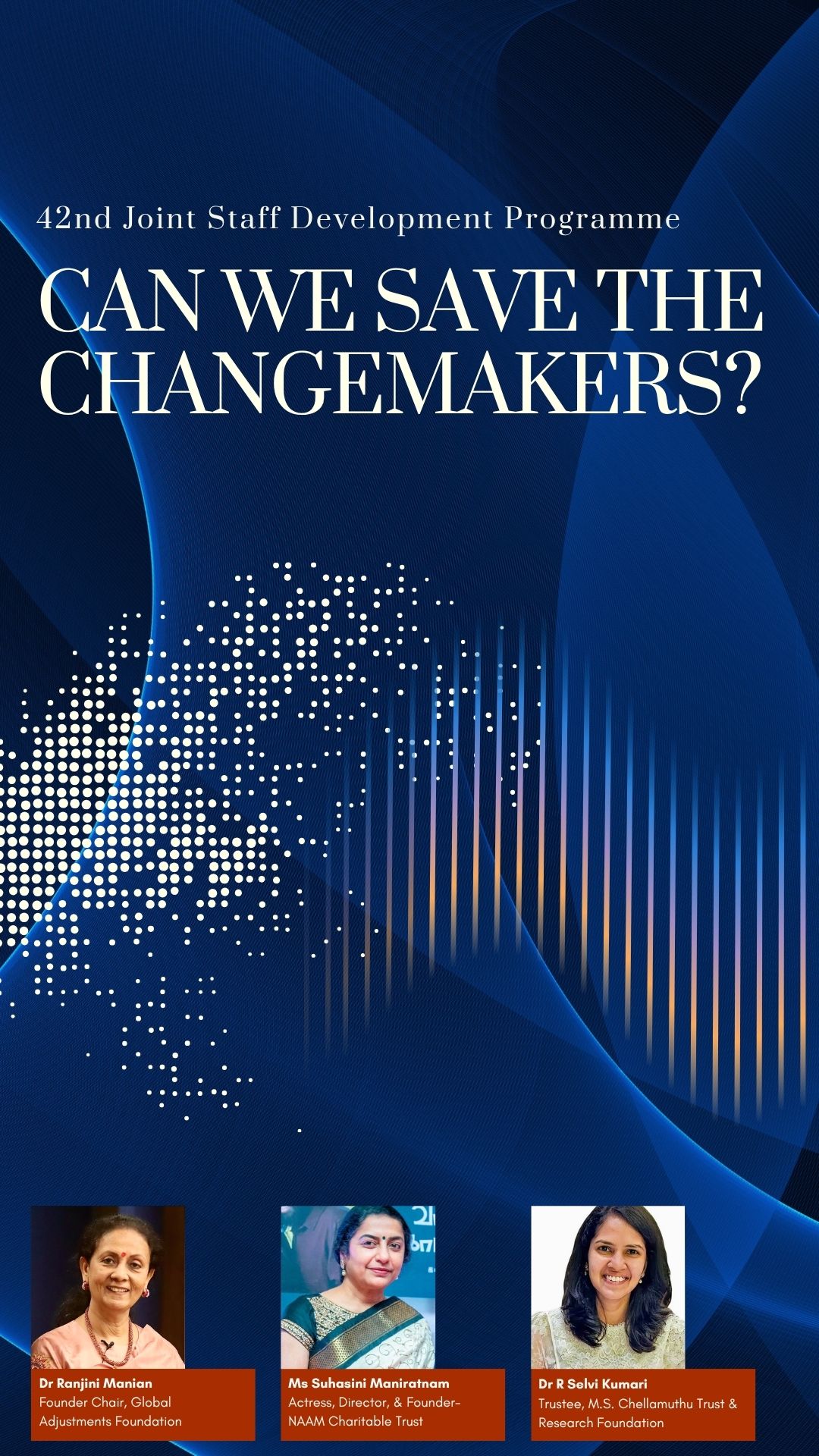
Panellists discuss the book, “The Mirror Within: Unveiling Hidden Perception through Image Audit,” and focus on how every organisation has two identities — the one it believes it projects and the one stakeholders actually experience. Understanding the difference is the essence of image audit.
May corporates fear this exercise
Prime Point Srinivasan
Founder & Chairman, Prime Point Foundation and Digital Journalists Association of India
This book was born from a moment of rediscovery. About a month ago, MMA organised an online programme on why exit polls and opinion polls fail to reflect voters’ views. I was a panelist along with Mr T S Krishna Murthy, former Chief Election Commissioner, and another poll analyst. During that discussion, I made references to the concept of image audit and how perception shifts. After the session, Group Captain Vijay Kumar asked me why I had not put these ideas in writing. I told him I had written everything fifteen years ago, but it was sitting somewhere on a hard drive. He insisted I retrieve it and make it useful — for the corporate world and for management students.
I went back to my archives. Seven or eight newspaper reports, detailed coverage in The Hindu, material from my blogs — I pulled everything together. My colleague Romesh Sundaram, a senior journalist, helped me locate original reports in PDF form. Within twenty days, working intensively, the entire book was complete. It is now freely available to everyone — scan the QR code, download it, read it, and share it.
The core idea of this book is straightforward: perception gets formed whether we intend it or not. To demonstrate this, I asked everyone in today’s audience to scan a QR code and answer just two questions — their first impression about two names. The results came back instantly: one name drew 100% positive responses; the other drew 100% negative. All of you come from different professions and different environments. You did not consult each other. Yet your first perceptions were identical. That is the power — and the danger — of perception.
How does perception form? In the book I have explained five primary sources. First, direct personal experience — the hotels we prefer on our travels, the brands we seek out, are all products of experience. Second, the performance of an organisation over time. Third, what others say — many of you have never met Dr A P J Abdul Kalam, yet every one of you holds a positive perception of him, shaped by what you have read and heard. Fourth, rumours, which are especially dangerous in the age of social media. Fifth, manufactured illusions — narratives deliberately constructed to create a particular image of a leader or institution.
The deeper challenge is the hidden perception. In an organisation of four or five thousand people, every individual carries an inner opinion that rarely surfaces to management. People say ‘excellent’ when they mean something entirely different. These hidden perceptions form patterns — trends — that eventually shape outcomes, whether in corporate results or election verdicts.
The idea for image audit first came to me in the 1980s when I was a branch manager at Corporation Bank in Bangalore. I noticed something on long train journeys: complete strangers would share family secrets they had never disclosed to their own spouses or children. Why? Because the listener was anonymous, there was no consequence, and there was a genuine human urge to ventilate — to express what is held within. I harnessed that insight. An image audit creates precisely those three conditions: anonymity, group setting, and an independent third party with no stake in the outcome. The result is honest, unfiltered perception — a master health checkup for your organisation.
Many corporates fear this exercise for the same reason some people avoid a health checkup: they do not want to know the results. But just as ignoring high blood pressure does not make it disappear, ignoring an organisation’s hidden perception only amplifies the risk. The image audit is a proactive leadership tool. It tells you where the virus is, so you can deploy the antivirus before the damage becomes irreversible.
Image audit scores should become standard governane practice
C Siva Kumar
Member, MMA Managing Committee; Director, Roots Industries India Ltd & Partner, Timelinks
It is a genuine privilege to release this book, and I want to connect it immediately to lived experience — because that is what makes Prime Point Srinivasan’s work so resonant.
I ran an industry through twelve years of loss. During that difficult period I had time to study something that troubled me deeply: why was there such a profound divide inside my own company? In Hosur, where my factory was located, colourful flags outside every gate signal the number of unions inside. We had many. One day, a worker came to me and said something I will never forget: ‘Sir, I am a helper. My son will be a helper. My grandson will be a helper. You are in management. Your son will be a Managing Director. Your grandson will be a Managing Director. So everything you do is for yourself — not for us. The only way we can get what we want is to rebel.’ I came back from that conversation with a homework assignment to myself: how do I change not just a perception but a reality?
The answer I found was not extra salary or perks. It was education — but not an education allowance, because cash can be redirected. Instead, I connected each worker’s child to a mentor in Chennai who matched the child’s ambition: a child who wanted to be a lawyer was connected to a lawyer; one who wanted to be a cricketer, to a cricketer; one who wanted to be an engineer, to an engineer. The only instruction to mentors was: do not give gifts — just guide. When that mentorship programme took root, my factory workforce grew from ten to twelve hundred. In that twelve hundred, there was not a single day of lockout, strike, charge sheet, or suspension. That transformation was only possible because I first understood the hidden perception of my people.
When I browsed through the chapters of this book, I found exactly the methodology I had stumbled upon through trial and error — laid out with scientific rigour. Prime Point Srinivasan has provided a clear pathway to surface what employees actually think, using open-ended questions in an anonymous, external setting. The examples in this book are remarkable. In one reputed college, the chairman was about to dismiss a professor he considered underperforming. The image audit revealed that this professor was rated by students as the institution’s single greatest asset. The chairman said he would have been a great sinner had he dismissed him. Instead, he promoted the professor.
In another case, a college introduced free remedial tuition for average students, using its best staff. A well-intentioned gesture — yet the student survey showed strong dissatisfaction. Probing deeper revealed two things: students felt punished by having to stay longer, and logistics made going home difficult. Simply providing transport resolved both issues, and those same students began recommending the college to others.
The book also argues for something that should become standard governance practice: image audit scores should appear alongside financial audits, quality audits, and cost audits on a company’s balance sheet. People are an organisation’s greatest strength, yet the alignment of people to organisational purpose remains unmeasured and invisible in most boardrooms. If image audit scores were disclosed with the same transparency we are beginning to demand for climate metrics, I am convinced share prices would reflect it positively.
A manual for stakeholder leadership
K Asokan
Editor — Kumudam Weekly, Kumudam Snehithi & Kumudam Bakthi
There is a line I would like to offer as the essence of this book: a person who cannot see the truth through the eyes of others is blind, even if they have eyes. That is what image audit gives you — the eyes of your stakeholders. And in an era when leaders at every level are surrounded by people who tell them only what they want to hear, those eyes are invaluable.
I have known Prime Point Srinivasan for nearly four decades. In fact, it is I who gave him the name ‘Prime Point Srinivasan’ — and he has carried the glory of that name ever since! More seriously, I have watched this work develop over a very long time. What he has written here is not theory. It is field knowledge, refined over decades of conducting image audits for banks, colleges, manufacturing companies, and public institutions. The methodology is meticulous, the ethics even more so: every report is confidential, shared only with the commissioning organisation, and the raw data is destroyed once the engagement is complete.
From a journalist’s perspective, I see this book as a manual for stakeholder leadership. In journalism, we are taught that the reader’s perception of your publication is your reality, regardless of what you believe about yourself. The same principle governs every institution. You may believe your organisation is performing excellently. Your employees, customers, and communities may hold an entirely different view. The gap between those two realities is where reputations are made or destroyed — and it is precisely that gap which image audit measures.
What strikes me most is the courage this book asks of leaders: the courage to commission an honest diagnosis, and the further courage to act on what they find. In my experience, the second is far harder than the first.
Questions & Answers
What are the key indicators that an organisation urgently needs an image audit?
Ask yourself the same question you would ask about a master health checkup — when should I go? The honest answer is: always, but especially when there is a gap. Every organisation exists on three levels: what it truly stands for, what its leadership believes it stands for, and what its stakeholders actually perceive. When those three diverge significantly, an image audit is not optional — it is urgent. Unfortunately, many organisations in India believe they are the best, and that very confidence prevents them from testing themselves. I have personally seen the cost of that attitude. In one multinational company with over five thousand employees across three shifts, I conducted an image audit and submitted a report identifying that ten to fifteen senior people on a particular floor were very likely to leave. The CEO paid my invoice promptly but did not read the report. Forty-five days later, those people had resigned. When the Chairman from America arrived and discovered what had happened, he was furious. Paying the consultant’s bill and acting on the consultant’s findings are two very different things.
How does image audit differ from an employee survey or feedback system?
An employee survey is conducted by the management. The moment an employee knows the management is reading their response, the instinct to please the boss overrides honesty. We all do it — it is human nature. Image audit is conducted externally, by an independent third party, in a group setting, anonymously. Those three conditions together produce something an internal survey simply cannot: the hidden perception. I have seen people who write confidently in anonymous sheets put the pen down the moment they suspect someone is watching. The questionnaire design matters enormously too — most questions use a scale, but I always include zero as an option. When a CEO once asked me to start from one instead of zero so that ratings would be slightly higher, I refused. The zeros are the most valuable data points in the entire audit. Every respondent who gives a zero is telling you something no paid consultant would dare say to your face.
How do you identify and leverage silent workers who are consistently overlooked?
This is actually where my entire journey with image audit began. When I was branch manager at Corporation Bank in Bangalore, I distributed questionnaires to walk-in customers one day — 150 responses. I included a question: name one staff member who has helped you most. There was a colleague next to my cabin who never spoke more than one or two words. I had been planning to request his transfer. When the results came back, more than seventy percent of customers had named him as the most cooperative staff member. I was stunned. Silent workers are consistently mistaken for disengaged workers. Communication does not mean talking. Communication means getting things done — and done well, quietly, consistently. The image audit surfaces what management cannot see because management is not watching the right things. Silent contributors are often the organisation’s greatest hidden assets, and the audit reveals them.
How is corporate image audit different from political perception management?
The purpose is the same — understanding hidden perception — but the conditions are entirely different. In the corporate setting, we conduct the audit in a calm environment, with no competing noise, no incentives distorting responses, and no hype. In politics, you conduct it in the middle of a storm: blaring music, massive media campaigns, manufactured narratives, and what I call ‘fence sitters’ — approximately fifteen percent of voters who decide at the last moment and who are the greatest challenge for any political strategy. An election is, in a sense, an image audit conducted in a noisy atmosphere. The corporate image audit is the same exercise done with scientific rigour in a quiet room. Both reveal the truth. The difference is only in how clearly you can hear it.