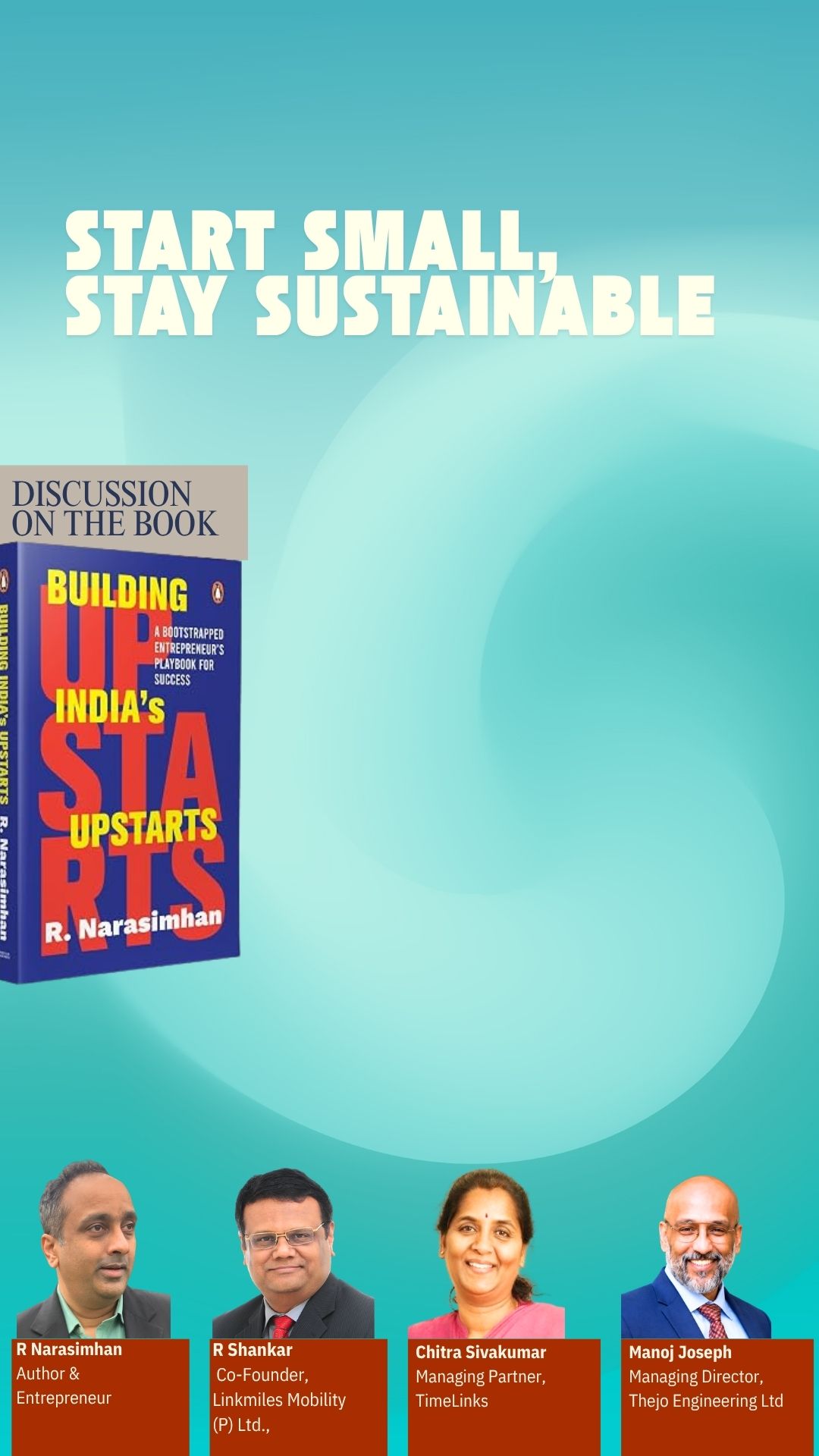
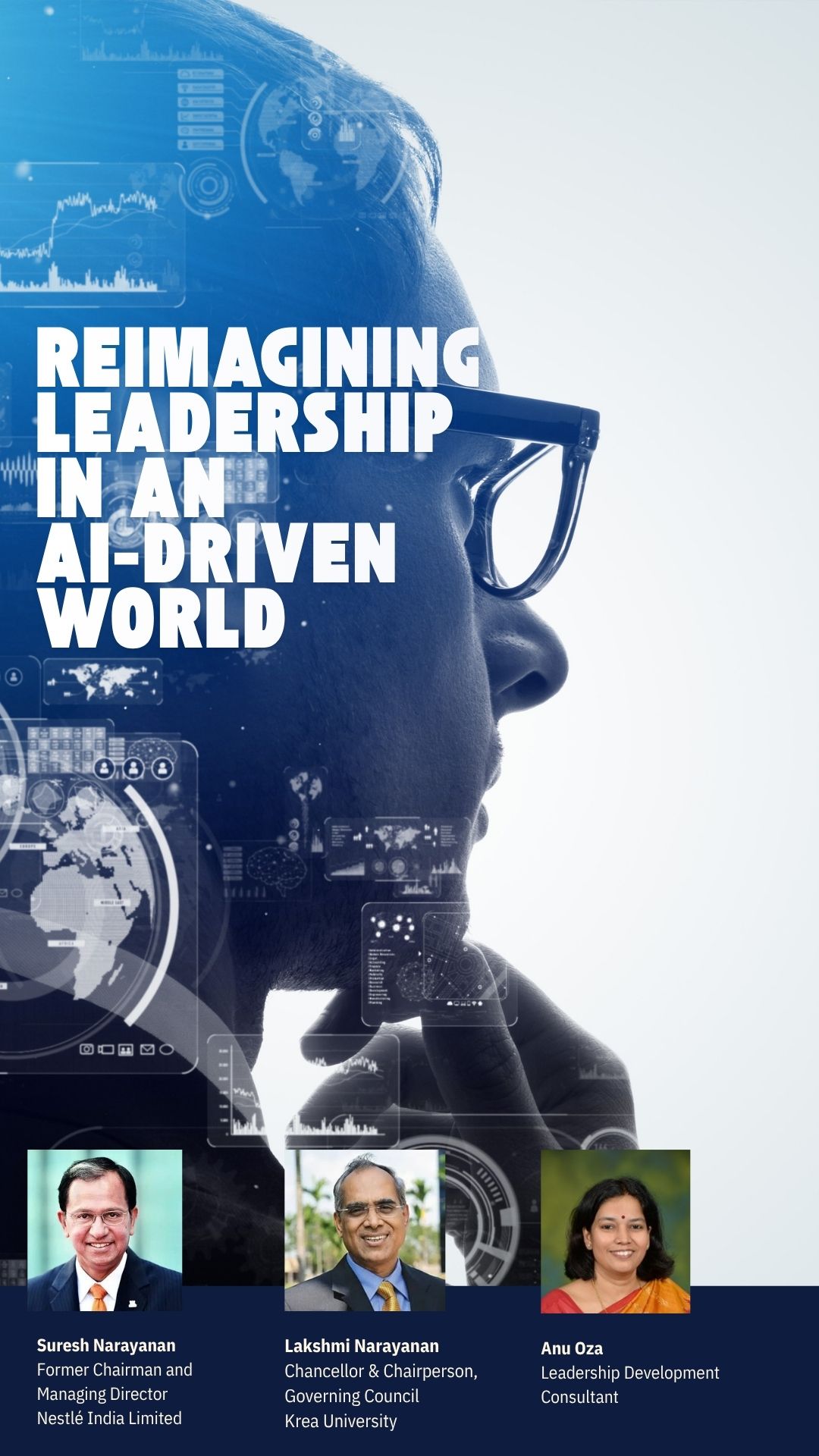
The session explored the intersection of storytelling, cultural continuity, and ethical leadership in contemporary India.
A Story Born Out of Necessity

Shoba Viswanath: When I entered this room, at least four or five people told me how their children had grown up on Karadi Tales. As a publisher—more so than an author—this is the most heartwarming thing to hear. Over 28 years of this journey, I still meet parents and even children who now have children of their own, spanning across two generations, who continue to read and listen to our stories. That, I believe, is the greatest testament to our work.
Wedded to Music
We are told that we are shaped by the associations we keep and the people who influence our lives. In that regard, I was incredibly fortunate to marry into a family of musicians. My husband is a musician, his brother is a musician, and my mother-in-law was a musician. Alongside their musical talents, they were also engineers and doctors. Coming from a less academically distinguished background, this environment was truly fabulous for me. In fact, I feel that much of what I have learned comes from my husband’s family rather than my own parents, though my parents influenced me in their own way.
The mothers of our generation were often critical—not in the way mothers today focus on preserving their child’s happiness and self-esteem at all costs. We were constantly encouraged to improve, to be better than what we were. If you got 99 marks in the exam out of 100, parents will ask, “What happened to that 1 mark?” That shaped our upbringing.
I wouldn’t call Karadi Tales’ inception accidental—rather, it was born out of necessity, as they say, “Necessity is the mother of invention.” I was an educator with a master’s degree in special education, while my husband, a musician, was also employed at an MNC. We lived in the United States for six or seven years, during which our son was born. I would take him to community libraries where I introduced him to audiobooks. At the time—back in the era of cassette tapes—you’d place the cassette into a player, sit with a book, listen to the narration, and turn the pages along with the story. My son listened to these audiobooks, and by the age of three, he was reading and writing independently.
The Birth of Karadi
When my husband and I returned to India, we looked for similar audiobooks for our daughter, only to find that none were available. So, we decided, “OK. Let’s just put a book and a story together.” I could write, so I wrote the first few stories. My husband, his brothers, and their wives composed the music for the books. And that’s how the idea of Karadi Tales as an audiobook began.
Many in the North are familiar with only a handful of South Indian words—perhaps “idli” and “dosa.” While curating stories for retelling and republishing, I discovered that there were hardly any stories featuring a bear, a Karadi. There was just one story, but it was about friendship rather than the bear itself. And yet, bears are integral to Indian forestry. So, I decided to make the bear our storyteller—the voice of all our stories—not as Balu or Ballu or Teddy, or simply “Bear,” but as Karadi. And that’s how Karadi, the storyteller was born. My husband and his family provided the music, and we brought film actors to lend their voices to Karadi.
Karadi Gets Its Voice
Our first book was narrated by Naseeruddin Shah. We were all based in Bombay—grew up there, studied there—and admired theatre artists, with Naseer being one of them. Even today, when people tell us their children grew up with Karadi Tales, it is often Naseeruddin Shah’s voice they fondly remember. We began with a book and cassette, which later evolved into a CD, then a USB drive, and now everything exists in a cloud.
It has been 28 years—soon to be 29 this July—since we embarked on this journey. I use “we” deliberately because, although I am an integral part of Karadi Tales and one of its founders, that’s what I am—one of the founders, one of the co-creators, one of the team members. This journey was never just about me; it has always been about all of us.
The Quest for Truth

Dr V R Devika: I believe every Indian has an opinion on Gandhi—whether positive or negative. But does truth and nonviolence work in today’s world? Does it have relevance in contemporary life? Many say “No.” But let me ask you: in your corporate workspace, in your marriages, in your friendships—do you expect honesty from your colleagues, your subordinates, your spouse, or your friends? Perhaps not always, but honesty is something we value, isn’t it? Gandhi never saw truth as a separate concept—it was always paired with nonviolence. For him, truth and nonviolence were composite words, because the intention behind truth and its use mattered just as much as the truth itself.
Dancing To Teach
How do I bring this idea to life? I began my career as a kindergarten teacher, later teaching MBA students and beyond, but I have always considered myself a kindergarten teacher first and foremost. Then, I learned dance—not to perform, but to enhance my teaching. I told my teachers, the Dhananjayans, that I would learn Bharatanatyam only to become a better educator, using it as a tool in my classroom. I never intended to do an arangetram or perform on stage, and they were happy with that. In fact, their son was my student.
How do I integrate the principles of truth and nonviolence into teaching children? The first lesson in Bharatanatyam is an acknowledgment of the earth. The key difference between Western classical dance and Indian classical dance lies in the dancer’s challenge. Western classical dancers strive to defy gravity, sculpting movement in the air. Indian classical dancers, however, work within a framework of time—everything is meticulously counted and choreographed.
Saluting Mother Earth
How do I introduce truth, nonviolence, and respect for diversity to kindergarten children? I created a lesson where, with my soul and body, I salute all of existence—Mother Earth, who stands as my partner, influencing all my decisions. I acknowledge all people, of all religions, all colours, all languages, along with the plants, animals, rivers, rocks—every entity that shares this Earth with me. The dancer, in this case, extends to the periphery of the circle, embodying the spirit of inclusion. In my math lessons, I incorporate storytelling with mudras and musicality, consistently reinforcing the idea that everything—every insect, every person of a different age or background—shares the same life force. This philosophy shaped how I approached education.
Celebrating Sarees
I even made a conscious decision to wear only handwoven textiles after realising the immense effort that goes into creating them. When I saw the loom being set up, I recognised it as an intricate engineering model. As a teacher, I felt that my voice needed to reflect this appreciation of and respect for craftsmanship. Every time I wear a sari, I celebrate the weaver. I have travelled across 29 countries wearing only saris.
I recall a conference in Washington, D.C. During that trip, I forgot to pack appropriate shoes. After checking in at the airport, I realised I was wearing slippers—completely unsuitable for a cold November in D.C. Luckily, I found a store selling sports shoes at the airport. I bought a large pair and wore them with my saree. Upon arriving at the conference, I was called to speak on stage after representation by Norway. The setting was grand—a ballroom with chandeliers, an audience dressed in their finest.
I stepped onto the stage in a stunning Kanchipuram cotton saree, a rich blue-green with golden borders, woven with floral and animal motifs—paired with these bulky sports shoes. And I began my speech: “Whatever you have heard about India, the opposite is also true—whether good or bad. Here I stand, exemplifying this reality. This saree was woven by a craftsman who barely earns $50, yet look at the artistry it holds. And I wear it with these shoes. India is a nation where billionaires live alongside jostling slum dwellers, where tradition and modernity coexist effortlessly. I am a modern woman—I drive, I live alone, I travel the world—and yet, I am deeply rooted in tradition. In India, modernity and tradition walk hand in hand.”
Be True
Gandhi’s presence is always part of my speeches. I have delivered over a thousand presentations on him, engaging with audiences who raise heated debates and challenging arguments. But I remain steadfast in my belief that Gandhi is still relevant. One of my final slides in every presentation reads: “Be True”—M.K. Gandhi.I ask my audience, “What is he saying? He’s not telling us to ‘speak the truth.’ He’s urging us to ‘be true.’ What does that mean?” I leave you with this thought. Please reflect on it.

Amudhavalli Ranganathan: Devika Ma’am. That truly demonstrated that perception depends on the mind and the eye with which we view the world. Now, Shobha ma’am, as a leader in publishing, how do you use storytelling not just to entertain but also to instil values, culture, awareness, and leadership in young readers?
Shoba Viswanath: Isn’t that the role of publishing in general? Especially in children’s books, the choice of stories we publish holds immense responsibility. When we returned from the U.S., we were certain we did not want to give our children yet another Cinderella, Snow White, Pinocchio, or Lion King. To say that India is a treasure trove of stories would be an understatement. Even a single story can have multiple avatars as it travels across India.
The Vadai Takes Different Forms
Take, for instance, the classic tale of the fox and the crow. In Tamil, it’s the story of Kaka, Nari Kadai—where the kaka or the crow steals a vadai. In Goa, it steals a fish. In Punjab or Delhi, it may steal a piece of parantha. The essence of the story remains unchanged, no matter how it morphs across regions.
I sometimes wonder if the stories credited to Aesop originated in India, because many of the fables bear striking resemblance to our ancient folklore. The thirsty crow story, for example—where the crow drops pebbles into a pot to raise the water level—has deep Indian roots. In fact, relics from the Harappan civilization depict pots with crows on them, suggesting this story existed long before Aesop’s time.
India is a culture of stories and storytelling. It is woven into the fabric of our lives. When we were growing up, books were not a household staple. We had newspapers, listened to the news on the radio, and, on rare occasions, borrowed books from a community library for a small fee—perhaps 25 paisa—to read for a week before returning them. Owning books was a privilege, an entitlement. Our homes may have had dictionaries, but rarely did we have storybooks.
The Grandma’s Stories
What we did have were stories, and they came from everywhere—from our grandmothers, aunts, maids, uncles, and visiting relatives. Even casual conversations—gossip—were stories. Much later, when joint families disintegrated into nuclear ones and both parents began working, there was no grandmother at home to narrate stories. That is when storytelling had to be brought from outside, purchased, and handed to children as books.
Stories have always instilled values, ideas, and thoughts. I wouldn’t call myself a visionary or a leader, but what we did was take these stories—the ones we heard from our elders—and narrate them in the same way we experienced them. We found talented narrators to tell the stories. Then, we added songs, as icing on the cake. Think about Indian cinema—can you imagine a movie without songs and dance? It’s an experience, just like storytelling. Even when my grandmother told me a story, she would pause midway for a song or dramatic sound effects.
This is what we brought to our audiobooks—not just a simple reading of the text, but an immersive experience with music, songs, and a richly textured soundscape based on Indian ragas and classical music. That was the real magic. I didn’t do anything to instill values—the stories themselves did the work. It was the choice of stories that made the difference.
Amudhavalli Ranganathan: If I had to sum it up in one sentence, I would say: Think globally, but act locally. The content, values, and essence of storytelling remain universal. Whether it’s Punjab, Chennai, or Mumbai, the key is ensuring that stories reach the audience in a way that resonates with them.
Devika Ma’am. One question to you. Having spoken about Gandhian principles of truth, nonviolence, and meaning, as you rightly quoted, do you think they are still relevant today? And how can storytelling be an effective tool to spread these values in modern leadership?
The Tale of Dr. Muthulakshmi Reddy and Rukmini Devi Arundale
Dr V R Devika: Being a student of dance, I unexpectedly became a critic for newspapers, writing extensively since 1979 and interviewing artists. I had been influenced by the North American dance historians’ narrative on the roles of Muthulakshmi Reddy and Rukmini Devi Arundale in dance history, which often misrepresented their contributions and painted them as controversial figures. To counter that historical misrepresentation, I wrote two books. One was on Dr. Muthulakshmi Reddy, highlighting how and why she became an inspiration. Let me share one incredible story from these works.
Muthulakshmi was born to a Devadasi mother, a woman who, due to societal constraints, had no legal rights over the children she bore with a man. In that era, a married man could have a young girl as a companion, but the children born out of such unions had no claim to the father’s name or inheritance. These children were raised solely by their mothers and were only allowed to learn music, dance, and perform in public.
Despite these limitations, Muthulakshmi Reddy defied expectations. She became the first female surgeon at Madras Medical College, the first woman legislator, and a fierce advocate for women’s rights. She fought against the wet nursing system, championed equal property rights for women, and pushed for the abolition of dedicating young girls to the Devadasi system. One of the defining moments of her life was witnessing her younger sister die of cancer right before her eyes—this drove her to found the Adyar Cancer Institute, dedicating her work to cancer research and treatment. In the Legislative Assembly, she argued against the Devadasi system with political stalwarts like C. Rajagopalachari and Satyamurti. Her determination was unwavering and boldness unmatched. Interestingly, her husband, Dr. Sundara Reddy from Visakhapatnam, helped rehearse her speeches and that underscores how deeply invested they were in each other’s causes.
Then, we have Rukmini Devi Arundale, who followed in Muthulakshmi’s footsteps. Rukmini was born into a Brahmin household, and when she decided to learn Bharatanatyam, it created quite a stir. At the age of 16, she fell in love with a British man who was 42, and their relationship was met with intense opposition. Her mother, Seshammal, at the age of 80, supported the two against public opinions. There were letters to the editor in The Hindu newspaper against the marriage. There were editorials condemning their union, and protests erupted outside the Theosophical Society. Yet, her mother, Shamal, stood firmly by her side—despite being a widow in 1919. She boldly took her daughter and family to Bombay, arranged for a registered marriage, and defied societal expectations.
When critics protested against Rukmini’s dance pursuits, her mother remained unwavering: “She has a mind of her own—she will do what she wants.” Stories like these show us that, despite difficult circumstances, hope and resilience always prevail. These are the kinds of real-life stories I collect and share with children, young learners, and audiences to inspire them. My two books have sparked significant discussions in the world of dance and history, reshaping narratives and bringing hidden truths to light.