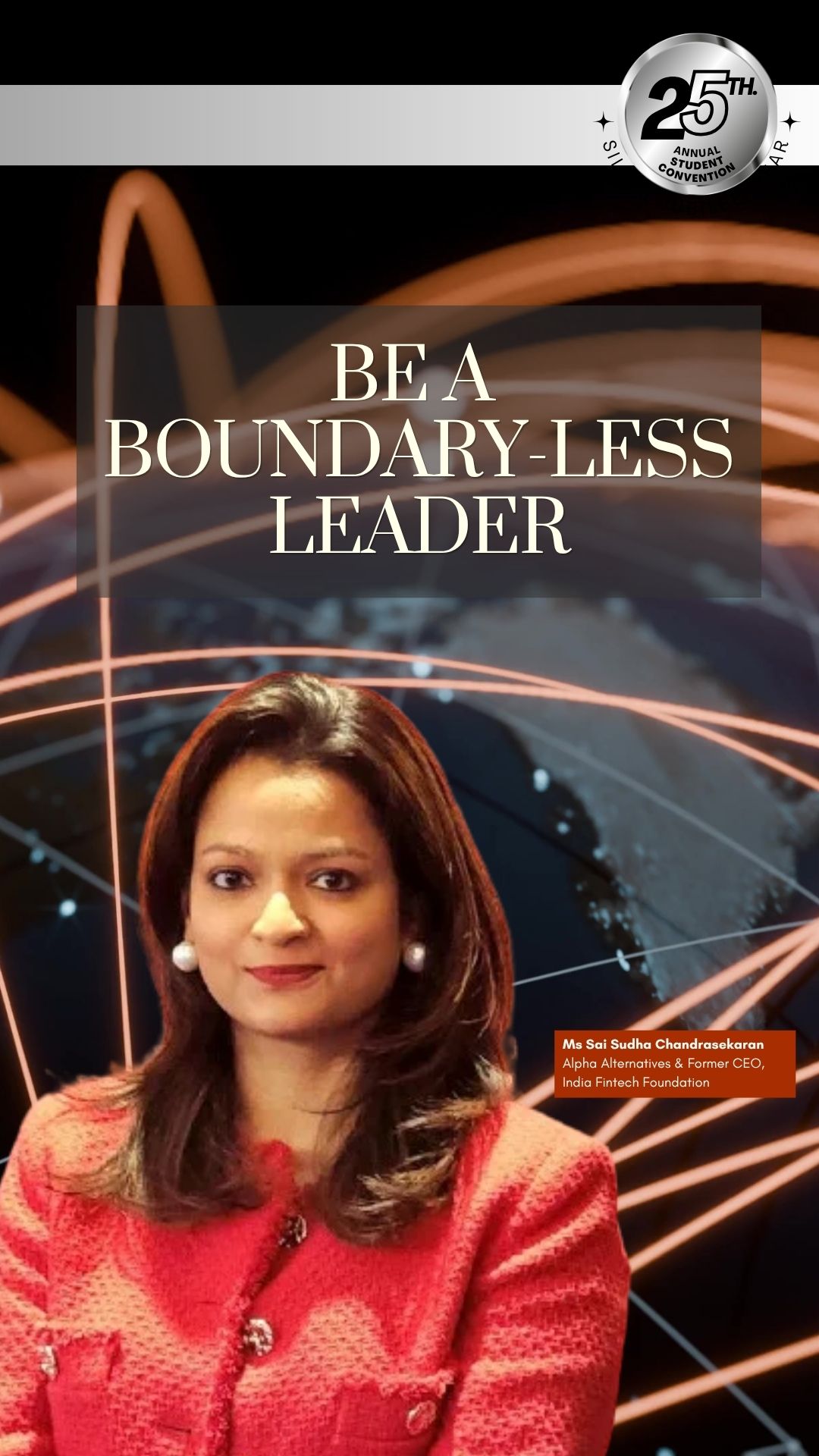
In her keynote address, Ms Sai Sudha Chandrasekaran explains why future leaders must work across business, government and capital, connecting ecosystems and executing with speed.
Ms Sai Sudha Chandrasekaran
Alpha Alternatives & Former CEO, India Fintech Foundation
It is a privilege to stand in a room that brings together some of the brightest future leaders of India and some of the finest business leaders Tamil Nadu has produced. When I was invited, I asked whether the organisers were sure, because looking at the lineup of the day, I clearly have more to learn than to share. But here I am.
When I thought about what I could say on the future of leadership, I realised that I spent almost all of my career preparing for a future I could not possibly see at the time. To me, that is itself a form of leadership: being open to change. Mr. Shyam says in his book Better Never Stops that you may have a plan, but you must still play the pitch. Peter Drucker made the same point when he said that the greatest danger in turbulent times is not the turbulence itself, but acting with yesterday’s logic. The ability to stay open and adapt is something I cannot stress enough.
For roughly 20 years, I have sat at the intersection of three seemingly uncorrelated worlds: business, government and capital. What I have learned is that India’s biggest opportunities do not lie within them. They lie in the spaces between them.
Let me trace how I got there. I started in the corporate world straight after graduate school, then moved to the US and worked in healthcare for a while. After that I moved to Hong Kong and became an entrepreneur, founding two companies. Both were about building platforms and connecting people. One was both B2B and B2C, and the other connected talent to capital between India and the Greater Bay Area. When I moved back to India in 2019, I asked myself what I knew nothing about, what would scare me when I went to sleep, and what would excite me when I woke up. Government looked like a good bet. It certainly scared me at the end of every night.
So I joined the Ministry of Commerce through Invest India, and I stayed for about five years as head of APAC, building FDI for the country. I worked with global capital and learned what investors need before they will come and set up shop in India. Then I moved to the fintech sector, not into a fintech company, but into an institution that would work for the sector as a whole. I took on the role of leading the India Fintech Foundation, a proposed self-regulatory body. The sector said it wanted to grow and listed what it needed. The government said it wanted the sector to grow. Both seemed to be sitting in silos, and somebody needed to build the bridge. That is exactly what we did. The Foundation merged with the Unified Fintech Forum, and I led it to become India’s second RBI-recognised self-regulatory organisation for fintech.
Then the same question returned: what scares me next, and what is important for me to build for India? I decided that understanding the language of capital, and being part of it, would excite me and help me contribute to India’s growth. So today I represent the alternative investment space. I have joined Alpha Alternatives, a three-and-a-half-billion-dollar, Indian founder-led, multi-asset-class alternative investment firm.
On the surface, these look like completely different chapters. To me, every move took me one level deeper. I have spent my career connecting businesses with opportunities, entrepreneurs with institutions, global capital with India, and industries with the regulator, all in service of one question: how can I help businesses create more value, for themselves and for India? That is the very essence of future-ready leadership, because I believe the biggest change in management today is not technological. It is foundational. It is structural.
For decades, we have been taught to think in organisational boxes. The CEO runs the company. Regulators regulate. Government makes policy. Investors provide capital. Entrepreneurs build the product. Technology enables the business. Today it is no longer enough to be good at any single bucket. You have to be at the intersection of all of them. A technology decision can become a regulatory issue. A regulatory change can rewrite the economics of an entire industry. A geopolitical event can redirect capital flows. A government policy can create a new market. A technology platform can make or break consumer behaviour. A capital allocation decision can determine which companies, technologies and models survive, scale and thrive. The boundaries have disappeared. Whether you join as a manager, an analyst, an associate or a VP, you need to become a boundary-less leader, and yet so many of our management structures and leadership models still revolve around the old boxes.
The future leader needs a different set of capabilities, and it starts with changing your mindset and the way you look at opportunities. You need depth, but you also need connectivity. You need expertise, but you also need context. Do not plan merely to survive after college. Plan to thrive. Understanding the ecosystem around you is what determines the impact of the leadership you wish to have.
I learned this early at Invest India. My job, simplified, was to talk to large conglomerates outside India and tell them why they should come to India rather than Bangladesh, Vietnam or Mexico, and how I would get it done for them. I spoke to hundreds of investors holding global capital and looking for markets to grow in. They were not just asking how large the Indian market was. They were asking much harder questions. Can I find the right talent? Can I navigate the regulatory environment? How stable is policy? Can I get decisions made, and executed? Can I find the right partners? Can I trust the ecosystem? And perhaps most importantly, if I commit capital today, how soon will I see its impact: two years, three, five or ten? These were the first questions I heard from investors weighing fifty million, five hundred million or a billion dollars for India.
That exposure gave me a lesson I carry to this day: capital does not simply follow opportunity. It chases only the executable opportunity. India does not have a shortage of opportunity. We have entrepreneurs, technology, a massive consumption market, infrastructure, talent and capital. The differentiator will be whether we can connect all of it intelligently and efficiently.
When I moved from building FDI for the country into fintech, I thought I was changing paths. In fact, I was going deeper. I had been helping businesses succeed, and now I was helping an entire ecosystem evolve. My job at Invest India was to make life easy for a foreign investor to come to India, and I thought, if I am doing this for someone outside the country, let me do the same for Indian entrepreneurs, and make it easy for the Indian ecosystem to work with regulators and policymakers. Fintech was growing incredibly fast, with entrepreneurs, technology, capital and extraordinary innovation. But there was another side of the equation that needed to be addressed: regulation, consumer protection, governance, standards, responsible innovation and trust. Everything comes as one package now. They are no longer different worlds. An industry growing that quickly needed stronger institutional architecture, I had the opportunity to build it, and I jumped at it.
That taught me something I want every student here to remember: building a company and building an institution are fundamentally different exercises. A company asks how it can win. An institution asks how the whole ecosystem can become stronger, including by bringing together the people who compete with you. That is a different form of leadership, and a new-age one. You must create trust between people whose commercial interests do not align with yours. At one table you are a competitor, and at another you are a collaborator. When you are a competitor, you build a business. When you are a collaborator, you build an ecosystem. You must bring entrepreneurs, regulators, government and investors into the same conversation.
If I have to define the future of leadership, it is the ability to be a boundary-less leader. It took me 20 years to learn this, and smarter people figure it out on day one. You do not have to reinvent the wheel. I offer you my perspective, knowing that every turn of the wheel brings a different one. It is important to understand multiple perspectives and also build your own, because every student’s path is different. A boundary-less leader understands that the most important opportunities are not found within disciplines but at their intersection, and understands how systems interact.
This matters especially in the age of AI. Companies spend enormous resources ensuring that systems understand each other and interact across vast amounts of information. We should reverse-apply that to our own human ability. If we can teach a system something, and it becomes better at it, it is incredible that we can learn something back when it does something better than we do. That is how we keep human intelligence ahead of AI, or of the superintelligence we keep reading about. We should stop looking at events in isolation. We should ask what each event is connected to, what happens next, who is affected, and how the opportunity moves from one part of the system to another. The ability to connect the dots before it becomes obvious to everyone else is a vital form of managerial intelligence.
But connecting the dots alone is not enough. I learned this the hard way. Insight without the ability to execute is merely an observation, and an observation is worth nothing if you cannot act on it. You see the opportunity, understand the ecosystem and build the relationships, but eventually somebody has to pick up the phone, roll up their sleeves and bring the right people together to get alignment, solve the problem and move. The ability to see, connect and execute is, perhaps, the simplest definition of leadership I can offer.
After 20 years of understanding global capital, seeing how execution works in India, running a small business in a different land and helping build institutions, I realised I needed to understand the language of capital too. So I have joined the other side of the table. The timing is fascinating. It is not enough to have capital. You need sophisticated capital, patient capital and intelligent strategies to deploy it for growth and development. Capital is not passive. It shapes what gets built: which companies get funded, which technologies scale, which entrepreneurs get a first chance and which get a second, which industries consolidate and which businesses go global. Capital allocation is a form of economic leadership.
Let me leave you with five points I remember every day. First, build institutions from day one, not just businesses, whatever your role. Second, learn the language of capital from day one, because the way you solve problems fundamentally changes, and you will save five to seven years of your journey. Third, understand the ecosystem, not just your industry. Fourth, build relationships before you need them. And last, think in decades, but execute in days.
These are lessons I learned the hard way and the long way. I wish you all wonderful success, and I wish for many more managers, leaders and entrepreneurs to come from this hall. It is a pleasure, a pride and an honour to be part of this convention. Thank you so much.