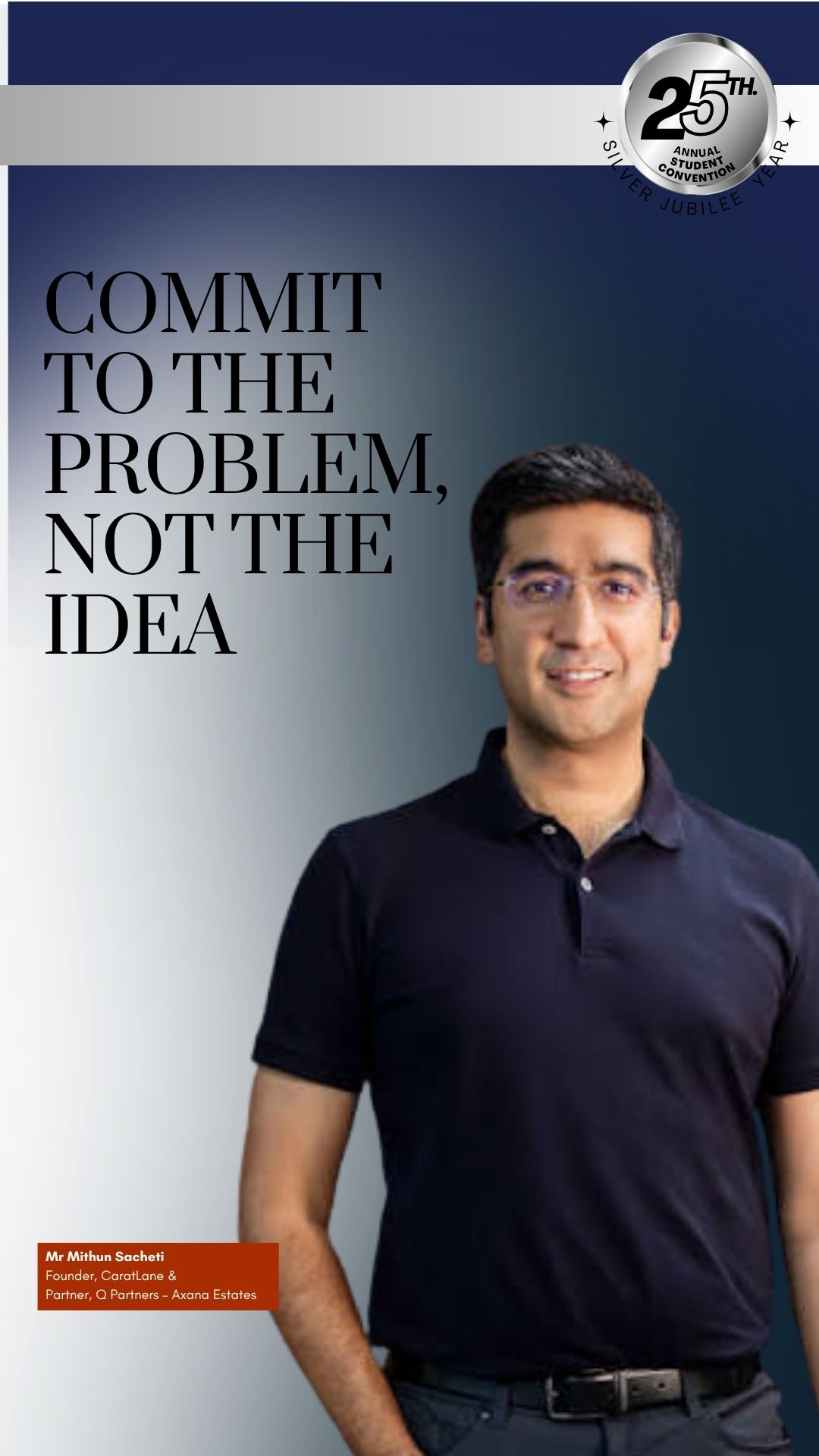
CaratLane founder Mr Mithun Sacheti shares hard-won lessons on staying with the right problem, ignoring permission, and building boldly with AI.
Mr Mithun Sacheti
Founder, CaratLane & Partner, Q Partners – Axana Estates
—————————————————————————————————————————————
Let me begin with a question. How many of you would consider buying a diamond ring online? A show of hands, please. I don’t see a single hand go up, and I like that. Now imagine that in 2008, I believed people would buy diamond rings online. That is the true essence of entrepreneurship. You hold on to a problem long before anyone thinks a solution is available. The only thing you hold on to is the problem. The ways you solve it will change every single day. Your focus has to stay on the problem your consumer faces.
I want to share five or six lessons that came from my own life while trying to solve the problems in front of me.
In 2008, everyone I spoke to told me that selling jewellery online was not a great idea. My biggest lesson, looking back, is that you don’t need anybody’s permission. If you believe in something, and you believe you can gather the resources to survive the next 18 months, chase the problem. Reassess after 18 months whether the problem still stands. If you have chosen it well, there is a customer out there who wants a solution. I come from a family business, and nobody gave me permission to begin. My parents thought it was a really bad idea. Some of my close friends were kind and said, “Try it, see what happens,” but the underlying message was that it was too early. I will tell you that every one of them was right. It was too early.
That brings me to the second lesson. Even if you are too early, if the problem is right, you must find a way to stay with it long enough. We came alive in 2008, but the problem really needed its solution in 2015. For seven years we were in the wilderness. We just had to keep surviving until the market and the customer realised that what we were working on would work. If you are early, find a way to stay with the problem, because if you don’t stay long enough, you have simply handed your idea to somebody else. Somebody else will build that business, and you won’t.
Even the original idea of selling jewellery this way was not mine. It belonged to someone who built a large jewellery company before me. He came up with the right idea, but he did not stay with it. He went for shortcuts to solve the problem, and those shortcuts cost him everything. At the core, though, he was solving the right problem. His life is not relevant to mine, but I have made it a rule that with every person I meet, I try to work out what I can take away that will improve my own journey.
One of the core tenets of CaratLane was that designation did not matter. I have had three jobs in my life. First I worked as a shopkeeper, then in a startup, and then for six or seven years at Titan, in corporate India. I know everybody cares about designation, because it is a way of marking hierarchy, and I have never been able to figure out the right answer to it. But I must tell you that when you work in the consumer field, it has to be devotion above designation. Every single person in the CaratLane leadership team had to read every customer’s email. By reading it, they were in touch with the customer and the problem. They also kept a timer in their heads. If an answer had not gone out within 30 minutes, and they were not copied on it, they knew they had to reply and take over the problem. Designation be what it may, devotion matters more to your customer than designation ever will.
A great deal is said about sunrise and sunset industries, especially if you are in the investing world, or if many of you spend your time on YouTube. You hear that you should chase the sunrise and put your money there. But there are very large sunset industries today where the rules are being rewritten, and with AI changing so much, the market is enormous. Jewellery was one such industry. Nobody thought of it as a sunrise industry, and yet it is having its biggest moment right now. There are more jewellery IPOs these days than jewellery stores opening. So look around you. Look at what you consume and what the people around you consume, and ask what could be a new way to run the same industry. You don’t always have to be path-breaking. You can solve the problems all around you. Big industries like garments are ripe for new entrepreneurs to come in and rebuild them.
Then there is the biggest elephant in the room for young people today, which is AI. AI does not take away your job. It makes you smarter. Many of you live in Chennai, as I do. When I spend time in Bombay, I am reminded that they consider us a tier-two city. I will be very honest with you: AI is the biggest game changer in my entire entrepreneurial journey. Sitting in a noise-free place like Chennai, you have all the information that anybody else has anywhere else. People in Bombay know what happens in Bombay, but Bombay doesn’t know what happens in Chennai or in the rest of India. With the solutions AI provides, the jobs that were hard to staff here no longer need so many people. Your own capacity multiplies by ten. You can build anything out of Chennai. AI solves the infrastructure layer that gave Bombay and Delhi their advantage, and it lets you build significantly bigger businesses from here. It is just a matter of how you look at it. If you are a builder, if you want to be an entrepreneur, AI is the biggest friend you will have on this journey.
I would urge you to spend as much time as you can with it. Some teachers might not like this, but even for your exams, build agents. Try to figure out what you can do with them, because in real life you will have to build them anyway, so you may as well learn now. Whatever ideas you have, whatever knowledge you want to gain, build agents for it, so that you can go out and build things that really matter to you.
Now I come back to the most important point I started with. On your journey to entrepreneurship, the thing you need to commit to is the problem. You don’t have to commit to your idea. The idea is simply how you have defined your answer to a customer problem you have identified. The ways you solve the problem will keep changing, and those are what we call ideas. What you must commit to is the problem, and not the way you have chosen to solve it at any given time. This is what pays the highest dividend. Nobody makes inroads by changing the problem every day. You make inroads by finding better solutions every day, because your experience keeps improving. Every time you talk to more customers and more people, you realise there is a better way to solve the same problem you chose.
If you really want to get into entrepreneurship, talk to ten people starting tomorrow. Find out where people are getting the most frustrated, because every time you sense frustration, that is an opportunity. The single biggest thing in my life was that it frustrated me that the family jewellery business was so inventory-driven. That became my opportunity in the long run. If you can find what frustrates you, and stay with it long enough to solve it, you will find it is your biggest moat, because you felt it yourself. Read how Uber came about, or Flipkart, or any of these companies, and you will see that it was always something that frustrated their founders. Stay with your frustration. Treat it as a problem. Keep working towards solutions, and you will figure out what you want to do with it.
Don’t wait to be future-ready. The future is today. Focus on that and you will build something unique for yourself. Someday, one of you will stand here and do a better job than I am doing now.
And if you need guidance, MMA is a great platform. I have seen how they connect anyone who is committed to them with the right people. If you have an idea and want to talk to people, MMA, TiE, and many other organisations in Chennai go out of their way to help you. I wish you all the best. I hope at least 10 to 20 percent of you become entrepreneurs, because this country needs that more than anything else. I look forward to sitting over there and listening to many of you. Thank you so much.