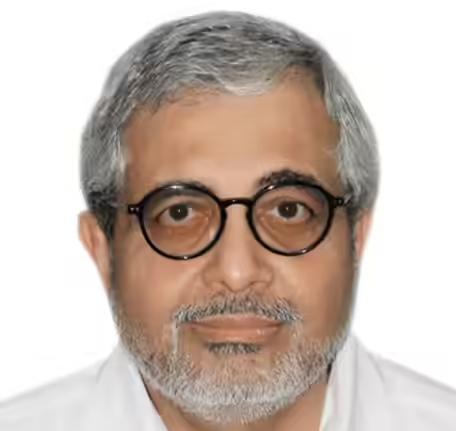
Mr. Nandan Unnikrishnan on India’s strategic positioning amid the Russia-Ukraine war, offering perspectives on Russia’s anticipated victory and India’s need for policy recalibration.
In the war between Russia and Ukraine, I’m afraid I will differ with Indrani fairly completely—literally the complete opposite. I don’t think anybody in the world today sees any option but a Russian victory on the ground, and I’m talking of a military victory.
The problem in our understanding of why it’s a Russian military victory probably stems from the fact that we are not clear as to what Russia views as a victory. Russia does not view territory as victory in this particular context. The Russian view is very simple: Ukrainian national neutrality. In other words, no membership of NATO and an incapability by Ukraine to either become a platform or to be able to launch any attack against Russia in the future.
I think Russia has reached a stage where those two primary objectives are, I would say, 95% achieved. So I really don’t see an option on the ground to anything but a Russian victory.
In this context, Europe is the one player that needs to readjust its worldview. Trump’s pivot of the last 48 hours clearly indicates that he understands that Russia is winning, and he’s decided to wash his hands off so as not to be blamed for this. He has decided that Ukraine can win back all its territory with the help of Europe, and he’s happy to supply any arms they want, but he is not going to get beyond that.
I also disagree about the fact that Trump is seeking any kind of deal—economic or otherwise—with the Russians. Trump is seeking to keep Russia as distant as possible from China, but that does not mean that he is necessarily looking at having a serious engagement with the Russians.
Let me be very clear: I believe Trump is not averse to the war in Ukraine continuing if Europe is handling it. He would like Russia to be distracted in Europe and stay away from China while he concentrates on dealing with the challenge that China poses to the United States. His vision of the challenge of China may not be one that impresses us, but the point is he looks at it from a very different perspective than what we look at it. This is something that Indians have to factor in when looking at the Indo-Russian relationship.
India’s Strategic Imperatives
One of the primary problems that I think today stand in the way of serious economic development between India and Russia is the question of sanctions. I’m not talking of the latest 25% tariffs or 50% tariffs on oil. That will get negotiated and will get removed. India will also adjust. We will substantially reduce the purchase of oil from Russia from its current levels.
That is understandable because the United States today is, in many ways, a far more important relationship for us, particularly given our developmental agenda. But we have to keep in mind that we cannot totally eschew our relationship with the Russian Federation, and therefore steps will have to be taken to keep that pot boiling, as it were.
In the context of the Russian war with Ukraine, I think India needs to recalibrate its understanding of where that war is and what kind of outcome we are going to see. If I was a gentleman sitting in the Indian foreign office, the questions I would be asking myself are:
- Is there any negative that I see in a Russian victory in Ukraine for India?
- Is there any positive I see in Russia not having a victory in Ukraine?
The answers to these questions would be the ones determining the recalibration of my current policies towards Russia.
Overall, I would say that we have handled the situation well. We are equal contributors in military terms to both sides. We are equal contributors in economic humanitarian aid to both sides—I’m advisedly saying both sides. Of course, on the economic front, our purchase of Russian oil is of immense help to the Russians given that they need areas to market their oil.
The Russia-India-China Triangle
There was a question about the long conversation Putin had with Modi during the SCO summit and how the relationship between the Russians, Indians, and Chinese will develop in the context of BRICS and SCO.
I personally am sceptical about RIC at this point of time—the Russia-India-China relationship—because the India-China relationship is still at a very nascent stage in terms of getting on its feet after the trials and tribulations that followed Galwan in 2020.
However, I am also very clear that if any Asian security architecture is to be evolved to give some stability to this area, then it would be impossible without Russia, India, and China coming to some kind of common page of understanding, even if it is the barest minimum. To that extent, I think the three countries would have to interact with each other and try to evolve their views to a level of understanding what is the basic minimum of each other’s concerns.
As far as BRICS and SCO are concerned, I don’t think that the euphoria about these presenting alternative visions of the world is valid at this point of time. Yes, both of them are platforms in which countries are voicing their unhappiness with the current rules of the game in the world. But what is more interesting is that the rule maker till now—the United States—is also unhappy with the rules of the world as they exist today and wants to rework them.
This flux is, as Mr. Narayan said, a grim time. But I agree with him—there is no need for us to be pessimistic. For the simple reason, and this is where I hope we should understand: I am grateful that we are not yet a great power.
I am grateful, and I agree with Mr. Narayan, that we tend to attribute to ourselves far greater importance than we actually have on the world stage, and we should be grateful for that. There are some choices that we are not being asked to make, and we don’t have to make them. There are pressures being put on us to make certain choices, but we have to be very clear in our own minds that these are not necessarily choices that we have to make.
We have to be governed by our national interest, and our national interest has to be driven by our domestic policies, by the need for domestic development. The final thought I leave is this: if we have flawed domestic policies, we will never have a flawless foreign policy.