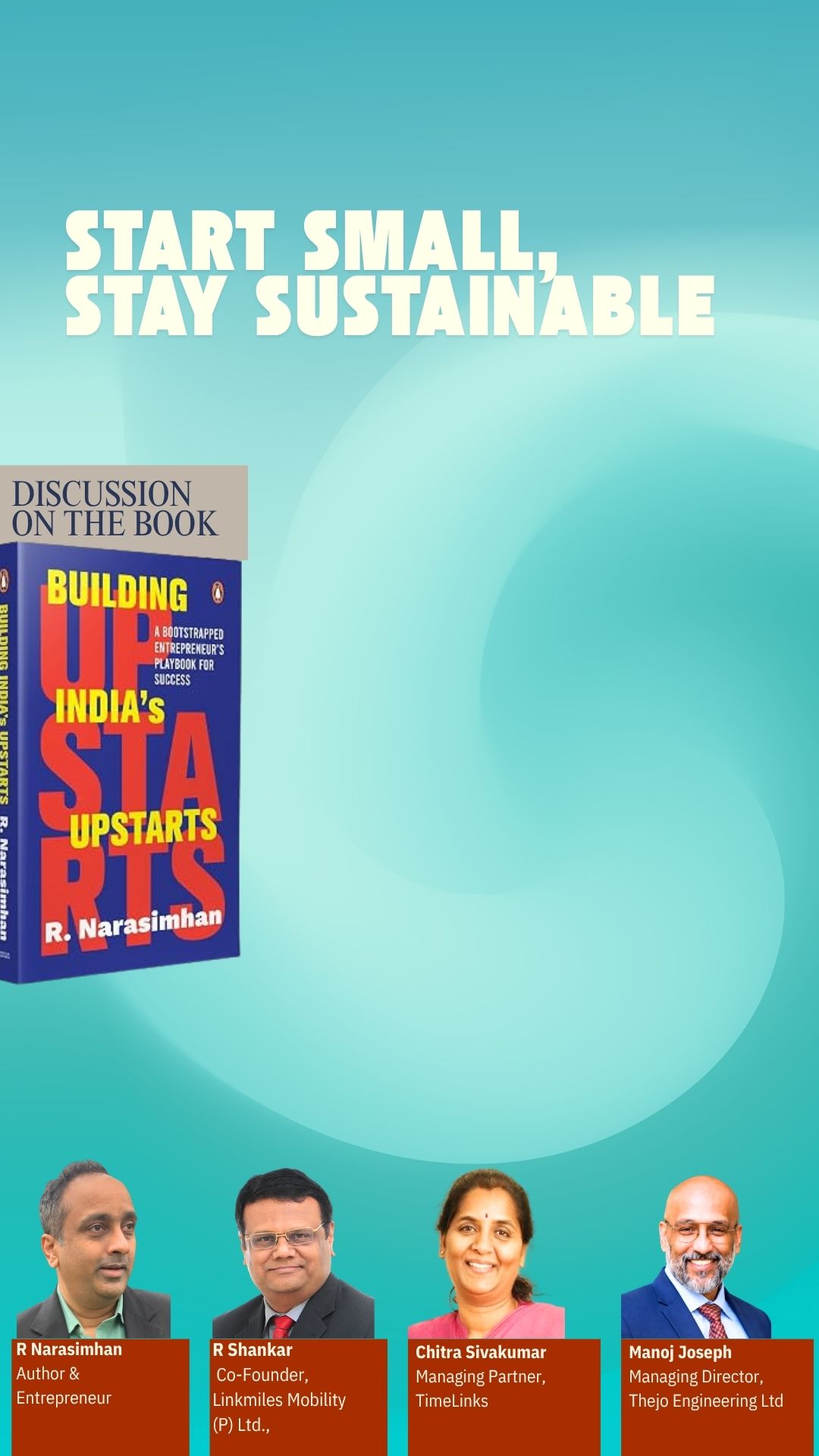
A discussion on bootstrapped entrepreneurship, highlighting sustainable growth, disciplined execution, customer value, prudent capital and purpose-driven business building.
R Narasimhan: Within ten years, 1.2 billion young people will enter the job market, while the World Bank projects employment for only 400 million. That is a shortfall of 800 million jobs, and India will feel it too. The sectors expected to generate work are infrastructure, construction, healthcare, food and agriculture, and entrepreneurship has a huge role to play in all of them. Demand is growing with our GDP, inefficient industries are waiting to be disrupted by enabling technologies, and what works in Chennai can be repeated in tier-two cities and tier-three towns.
Entrepreneurship is simple: there is demand, and you build a sustainable company that serves it at a price people will pay. Do not become an entrepreneur because you have a great idea, because the idea, the market and your assumptions will all change. Do not do it to get rich either. Statistically most companies fail, so the expected return is negative. Do it for autonomy, for purpose, for the impact you can create, because after ten years of nothing, money cannot be what keeps you going.
Age is not the test. You need the calling, a well-formed view of an industry, and clarity on what, where and with whom. Captain Krishnan Nair founded the Leela at 62. I chose to start alone, in Chennai, where I had cultural context, family support and could speak Tamil.
The conventional start-up creates a new product or a new market, raises venture capital and chases dominance. This book argues for the upstart. Build a better mousetrap at lower cost, start small, bootstrap, be profitable from day one and improve one percent every day. Parachute coconut oil, Haldiram’s bhujia, Asian Paints and Infosys all began small. Rural clinics, charging centres and small-town gyms are open to anyone. Build competency, understand your market, start small and keep improving.
R Shankar: Congratulations on this book. I come from the industry you built your business in, and after 40 years of work life I am now a bootstrapped entrepreneur myself. Traditionally, business families put in capital, build a sustainable business and hand it to the next generation. You built a business with that ethos, yet you sold it to a larger, VC or private-equity-funded company. I see a paradox. What made you sell rather than build a legacy that passes through generations?
R Narasimhan: I am someone who wants change. I was an academic, then a corporate professional, then an entrepreneur, and now an author. At some point I feel it is enough. As for legacy, I do not know whether children want to continue what their parents do. Some families run businesses for four generations, but I wanted my kids to figure things out on their own, with just enough capital to be competent. Fundamentally, after 15 years in an operationally intensive business, dealing with customers, suppliers, banks and regulators, I was simply tired. The right opportunity to exit came along, and I took it.
Manoj Joseph: In services, it often feels as though the client owns you, so I understand the exhaustion. I read the early chapters of your book, and I am intrigued. Someone employed in an organisation finds it easier to work than to take the risk of running a firm and being responsible for people. What was running in your mind when you took up this challenge? And what did your family feel? Your spouse and parents were watching you give up everything good for a risky path. How did they support you?
R Narasimhan: I had worked for a Silicon Valley start-up, and I did my MBA wanting to start a company. We are not a business family, so my fear was whether I would get a job if I failed. Someone told me, “You went to IIT, you went to Berkeley. If you are scared you won’t get a job, you’ll never be an entrepreneur.” That was instrumental. Today’s Gen Z says YOLO, and I did not want to look back and say I never tried. So I booked a ticket and came here. My wife was completely supportive. She believed in me more than I believed in myself. We all had angst, since I had never worked in India or in logistics, and I was told I was green and soft. I toughened up over time.
Chitra Sivakumar: Congratulations on a wonderful read. I have been an entrepreneur for nearly 30 years, and I am now deciding whether to expand further. When you are bootstrapped, you fight every day over costs, vendors to pay and delayed receipts. An opportunity may come along, and you cannot take it. A competitor with funding moves faster, takes the whole opportunity, and you lose the business. What would you suggest to the many entrepreneurs listening? How did you handle such a phase?
R Narasimhan: The question matters most between zero and a certain stage. Once a company is established, private equity and debt are available. Early on, you cannot grow faster than the capital you generate. For ten years I never saw our bank balance rise, because everything went into growth. Banks refused to lend because I had no balance sheet for four years. Yet capital carries risks. Delhivery raised capital and became massive, though it was not profitable when it listed. Rivigo raised $100 million, was on the cover of The Economist, and does not exist today. Your own money makes you far more prudent. You think ten times about ROI. Investor money invites risk-taking, which is partly why people get it.
R Shankar: You have written about value creation versus valuation, and about changing the pricing methodology of distance and time in an industry that was very different. Your book says customers initially paid more. Large corporations do not easily accept it when an upstart says, I am going to change your pricing model. In what is essentially a plain-vanilla service, what made you able to sell value to B2B customers?
R Narasimhan: I could not compete by doing the same thing. If I was not adding value, I would not survive, so I had to innovate. Risk-averse corporations resist, so I proposed small experiments and pilots, then expanded. Selling to the top is easier than selling to the operating person, who just pooh-poohs you, because if the idea goes belly up, they fear losing their job. We re-engineered warehouse racking to use less ground space. It is not rocket science, but it kept us alive.
Manoj Joseph: We face the same issue with our clients, who are bigger corporates. The top is fascinated by new ideas, but at the bottom people fear that someone is telling them how to do their jobs better, which means they become redundant. They will put spokes in the wheel to see that you fail. Convincing the top is one thing. How did you get the bottom to change?
R Narasimhan: You must make the initiative a win-win and find a champion. A friend once asked me whether I wanted glory or money, and I chose money. So I let the operating person be the innovator. At one customer, a plant we worked with showcased the result to the CEO, then trained 15 other plants. Everyone has to win. The transporters we displaced as a new service provider were retained, by policy. People asked what had changed, since the same people were operating. Only the system was different.
R Shankar: Your book opens with you in Brazil, living a nice life, and then ending up in a Chennai police station over a truck that got caught. For a youngster of 19 or 30, change is easy. For someone who has been a professional for 20 or 25 years, how must the mindset change? What did you feel, and what would you advise people making this change midcourse?
R Narasimhan: Initially I found it exciting, because I had never seen a police station in my life. After 15 years and ten police stations, I did not want to go near one. Whether it is court, a lost truck or a violation committed while I was asleep, you deal with it. I had no prestige about what I would do. In 15 years and with a thousand employees, we never had an executive assistant. I took my own printouts and fetched my own chai. Maybe I went to an extreme, once booking one room for three colleagues. That was pushing it too far, but I knew I was in this game.
Chitra Sivakumar: I recently attended a Tata leadership and strategy session, where the point was that execution matters more than strategy. Applause goes to the strategy people, and execution is forgotten. You feel passionately about this, and it is a lesson for entrepreneurs like me. What did you do differently, and why did you succeed?
R Narasimhan: Execution wins over strategy, because strategy can change but you must execute. E Sreedharan built the Metro on time and on budget. In India, process adherence was my toughest challenge. Tell people to do something, return six months later, and what is done differs completely. In service businesses, it is harder still. I just had to be at it every day. I would send a spreadsheet to be filled in, and the width of the table changed every week. Forget the numbers, I said, I want it done the same way. Saravana Bhavan’s coffee tastes the same in Anna Nagar and Mylapore. My team said they had a good cook. It is a process. I also gave people autonomy.
Manoj Joseph: The difference between manufacturing and services is huge. In manufacturing, it is easy to set standards and repeat them. In services, the methodology can be written to the dot, but how people understand and practise it varies enormously. Succeeding at that is commendable. I also like that your book is down to earth, simply put, yet narrative. Do not do it just for money, because without passion there is no business. If a person goes through your introduction and first few chapters, they need not do much more.
R Shankar:
You excelled in academics, studied at the best institutions in India and overseas, worked for global companies, came back, started up and exited. You also told me you get bored often and keep changing. What is your next calling?
R Narasimhan: I don’t know. I have written a book, and my second son goes to college in a few months. After that, I must figure it out. It is very tough to decide how to spend your time.
Chitra Sivakumar: You spoke of looking at an unorganised sector and working around it. I represent Tanishq, which also transformed an unorganised sector. If you were starting all over again in today’s India, forgetting that old chapter, which industry would you choose?
R Narasimhan: I feel strongly about work that provides employment and dignity, in an industry serving domestic demand. The aero bridge in Chennai is imported from Indonesia, the travelator in Delhi is made by a German company, and the hand dryer comes from Dyson. We push satellites with Skyroot, yet we cannot make a travelator. Eighty percent of what we do is domestic consumption. Poor Indians buy clothes from China, and housing is a struggle. Why can’t we build better, sustainable manufactured houses? If I started again, I would go back to foundational industries.