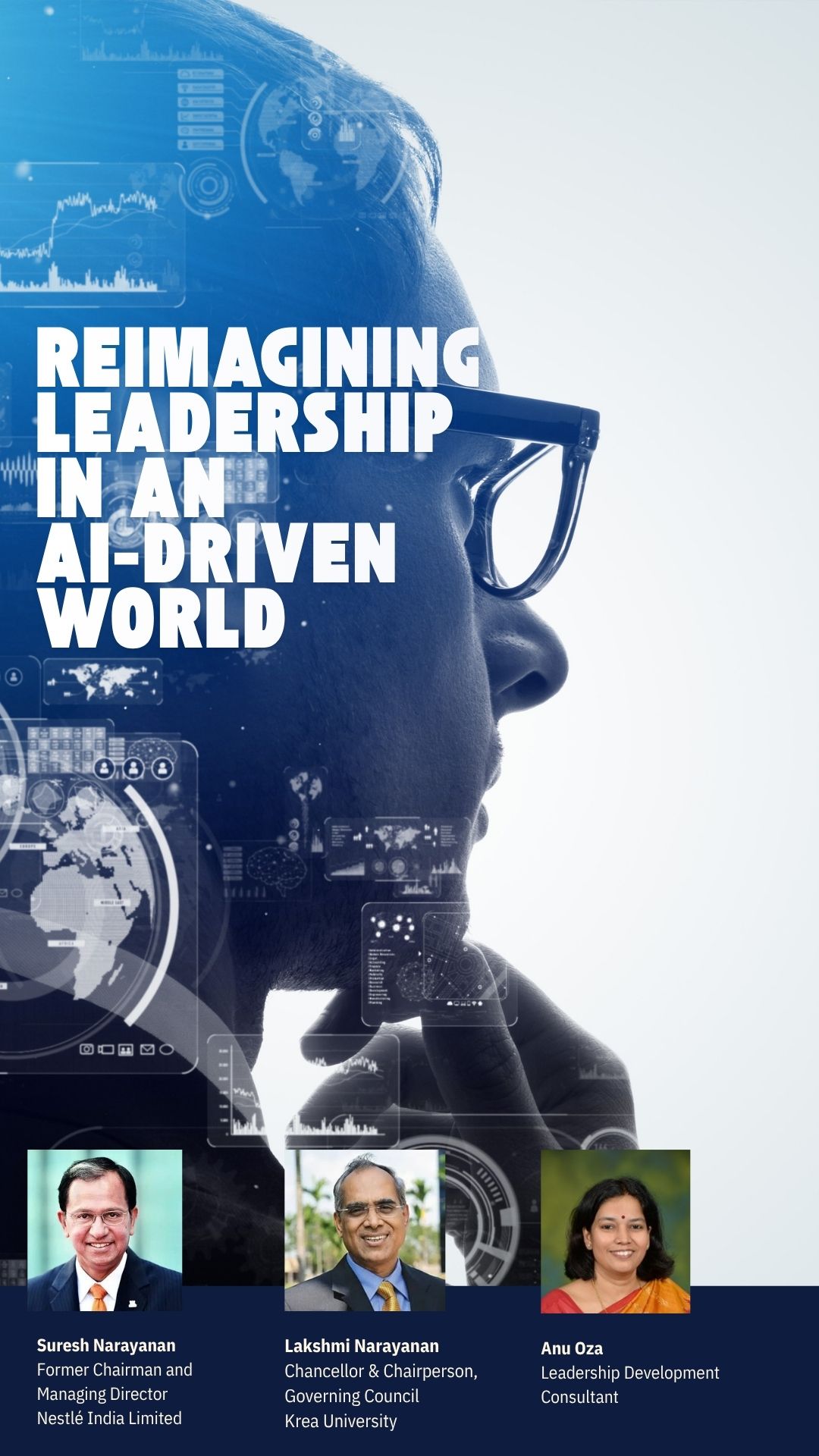
The panel explores how leaders can harness AI while preserving human judgment, empathy and ethical responsibility, and preparing future talent for change.
Mr Suresh Narayanan
Former CMD, Nestlé India Limited
Leadership is still relevant in an AI world. Four characteristics have made great leaders: agility, anticipation, assimilation and action. They will not change, whatever technology comes your way. Society also still has to exist. Our responsibility as leaders is to make sure the fabric of society is not torn asunder by the forces of technology. It is not either people or technology. It is people and technology. I have always believed that technology is meant to help mankind, not the other way around. Today we are getting it wrong, thinking technology will be the tail that wags the dog. Judgment, emotion, empathy, communication and conviction are purely human, and no machine has produced them in any meaningful way. The scarecrows saying AI will destroy humankind come from improper negotiation with the technology, not from the technology itself.
I have been asked how I would have responded in the Maggi crisis had AI been available. It is hypothetical, but one fact is clear: we got out of that tragedy because of people-centred leadership, not the force of technology. Still, AI could have speeded up our extraction. Collecting facts and putting them in analytical form, so you can convince stakeholders and regulators, would have been much faster. Summarising the analysis would have been possible with Claude, ChatGPT or any other model. We could also have painted alternate scenarios on recovery, market share, supply chain and manufacturing configuration. Those were analytically possible then, but not at speed. And AI would have helped in crafting standard communication quickly, though it tends to hallucinate and quote wrong cases.
The core issues would still have been beyond AI. When 7,200 people are at risk of losing their jobs because a company has lost 30% of its business, AI can come up with a compensation package. It can do nothing to assuage their mood and morale. An algorithm spits out what it has been taught; teach it garbage and you get garbage. Judgment is the ultimate call, taken after the analytics have been digested and a gut responds in a human way that a machine cannot. And media and stakeholders will not be happy dealing with a machine instead of human beings.
AI will become integral to our systems when protocols get defined. Today they are not, and we are paying the price in social media already. I don’t think we have any ethical guardrails for AI. We are in a feeding frenzy, almost a killing frenzy, eliminating jobs simply because we feel AI will affect them. Many retrenchments are AI-anticipated, not AI-done. AI runs on four things: capabilities, which are racing ahead; R&D, which is slower; integration into business; and productivity impact. That is Solow’s productivity paradox, where digital data does not yet reflect possible improvements. Electricity went the same way, with generation, transmission and factory adoption each a constraint before its capabilities were fully exploited. If your business model is no longer robust, that does not make AI responsible. It has more to do with strategy and leadership. What I want is leaders who calibrate rather than consolidate, bringing empathy, compassion and people back to the table.
In conclusion, AI can enhance the pace and quality of life, and it is probably a bigger change than any we have faced. But trillions of dollars are being invested without commensurate returns so far, and I hope it doesn’t become another dotcom bust. I am confident about the benefits but worried about the implementation. The proof of the pudding is in the eating. Let’s hope we make a decent meal of it and don’t get eaten up by the technology itself.
Ms Anu Oza
Leadership Development Consultant (Moderator)
Thank you, Suresh. That was an excellent speech, and your book is as much an indicator of human purpose and possibility in the age of AI, though it wasn’t intended that way. You gave us a bird’s-eye view of leadership. Several sectors, including software, fintech and consulting, are seeing structural change. Can we narrow it down to people-related issues in these industries, and how leadership can be exhibited in the age of AI?
Mr Lakshmi Narayanan
Chancellor & Chairperson, Governing Council, Krea University; Founder, ICT Academy
Congratulations on the book, Suresh. You made one point very forcefully: the gut feel and judgment many of us rely on cannot be replaced by AI. At the Economic Times 40 Under 40 awards, Ajay Perumal put it well: judgment cannot be outsourced. AI can help with data and communication, but human decision-making at the leadership level will not be greatly influenced by it.
From the book, I’d encourage you to test AI against the five leadership tenets of trust, values, behaviour, credibility and outcome. Take trust. Can you trust AI to make a decision? AI operates at three levels. It provides information and insight for humans to decide. It offers two or three alternatives for the leader to choose from. Or it is autonomous and decides by itself. So far, no AI system has shown it can be trusted with a completely autonomous decision. Outcome will have to be evaluated industry by industry. People-centricity is a no-brainer, but research institutions swear by AI because it solves problems that have been unsolved for hundreds of years. Whether it applies uniformly across sectors is something each of us must debate before deciding where AI fits in our leadership journey.
Mr Suresh Narayanan
Former CMD, Nestlé India Limited
Thank you for taking my five-principle model as a template for evaluating AI. For me, the more fundamental issue is the role of technology and the role of leadership itself. In corporates there is a keeping-up-with-the-Joneses spirit: everybody runs into a new technology because the competitor is doing the same. This fear of missing out dominates our discussions, with little serious thinking about outcomes versus process. Technology has steps: understanding it, incorporating it, getting the benefits and making it part of workplace habits. If that isn’t calibrated, change management can completely warp.
We already face an employment crisis, and educated unemployed are a significantly higher proportion than the overall unemployed. If we replace entry-level jobs with AI, what do we do with all these young people? A calibrated approach, like China’s guardrails on how far technology can go and how far people need protection, will matter for society to remain sustainable. That demands leaders who are not only capable but wise, with the wisdom to take a long-term view when many of us are measured by quarters. Maggi made a loss for its first 10 to 15 years in this country, but it persisted. Habits take time to form. Technology has to embed itself, and we must give it a period of reflection so that it works for us rather than we for it.
Ms Anu Oza
Leadership Development Consultant (Moderator)
Leadership means developing capacity across an organisation, not just in the person in authority. Is AI demanding leadership capacity earlier? How do we start that learning process? How do you teach judgment and business-critical skills to a 23-year-old graduate who must face a client? That is the seismic change in software.
Mr Suresh Narayanan
Former CMD, Nestlé India Limited
It is a very good question, Anu. A doha of Kabir captures this wisdom and maturity: everything in nature takes time, and watering a seed with a hundred buckets of water won’t bring the fruit before spring. Today there is a hastening of leadership maturity. Maturity comes with experience and a few knocks, and we aren’t teaching that to the young. The role models we create say that ten years makes you a CEO and twenty makes you god. It doesn’t work that way. Hard work, humility, empathy and compassion are being lost at the altar of speed and short-term results.
People-centred leadership will become even more acute when AI is in full bloom. Earlier you could live with inefficiencies because everybody was inefficient. Now a few will run ahead of the curve, and a young leader with little patience will do foolish things. Old corporations like Hindustan Lever, Nestlé or Colgate developed people through assignments, the ladder approach. Today it is fashionably called zigzag, but in a zigzag you could be off the cliff.
Leadership development must take precedence over everything else. I tell my HR fraternity to become champions of the skills and competencies the company needs for the next five to ten years. The business plan begins with the people plan, not with a balancing equation that says 20% growth means five hundred more heads, so go source them.
Mr Lakshmi Narayanan
Chancellor & Chairperson, Governing Council, Krea University; Founder, ICT Academy
Suresh made a very important point about planning for the future and developing leadership talent. It is not about extrapolating the past and growing at 20% year after year. It is about rolling the future forward: take a view of what is coming and see how you prepare. One example is a leader of a very large public-sector organisation with over a lakh employees. He said AI is not going to take jobs away, only make them worthless, and he chose to retain his people anyway. That is exactly what Suresh did during the Maggi crisis. No one was fired despite a 30% loss of revenue. The jobs may be done faster by machines, but he chose not to deploy them.
Ms Anu Oza
Leadership Development Consultant (Moderator)
Grooming talent should occupy a nation as much as an organisation. In fintech and software, people are being asked to show judgment and systems thinking much earlier. How do we change university curricula to prepare people, not just those entering organisations but the larger population? And what about the inequity of AI, where people lose jobs because they lacked higher-level skills at entry? The Gates Foundation announced a billion dollars yesterday to address social equity in AI. I’d like to ask you about both.
Mr Lakshmi Narayanan
Chancellor & Chairperson, Governing Council, Krea University; Founder, ICT Academy
Grooming students is a favourite topic of mine, and this is a bit of a marketing pitch. Suresh and I both sit on the governing council of Krea University. The education there is interwoven: liberal arts and sciences with a business school, where students are free to choose what they study. When it started, the vision was preparing leaders for an unpredictable world, about seven or eight years ago, and we are living in one now. In the IT industry everybody used to be growing, and you could make no mistake. Those days are gone. New-age companies must reinvent their leadership every four or five years. Bill Campbell, the Trillion Dollar Coach who coached Bezos, Pichai, Brin and Jobs, put people first and invested in learning and leadership development. Whatever the extent of AI, people still matter, and leaders matter even more.
Mr Suresh Narayanan
Former CMD, Nestlé India Limited
If I may do a little pitch for Krea too, there are very few universities like it in this country. For too long we have adopted a cookie-cutter approach, producing B.Com, B.A., MBA and B.Tech graduates for an era fast receding. Only 25% of our engineers are said to be employable. We also focus so much on strategic and analytical capability that we ignore the software that makes great leaders. Culture sounds more like agriculture to us. In the AI age, your agility, adaptability, authenticity and action will speak louder than words. If I were the parent of a teenager, I’d wonder what to tell them to study. The recalibration has to reach the curriculum, both hardware and software.
Ms Anu Oza
Leadership Development Consultant (Moderator)
I walked straight into the Krea trap. But not everyone will have access to such universities. Are we developing leaders only in a certain income bracket, or looking at the broader population? Forgive the question; I’m from the LSE, so there’s a slight left-leaning.
Mr Suresh Narayanan
Former CMD, Nestlé India Limited
Two things need doing. First, contemporise curricula, since some universities still sit on case studies from the 1970s. Second, and I say this with hesitation but in sincerity, an apprenticeship approach to trade skills will matter more than degrees. Not every child will get into an IIT, and we shouldn’t glamorise that or make it so elite. We must vocationalise training so the average student can earn a decent income, and AI’s impact there is likely much lower than on technology-intensive industries. In the US, saying your son is a plumber is no big deal. In India, people ask what kind of parent you are. But there is no other way to manage our numbers unless we seriously build better-quality ITIs.
Mr Lakshmi Narayanan
Chancellor & Chairperson, Governing Council, Krea University; Founder, ICT Academy
One example, without holding any brief: the new Sri City International University is located in an industrial township, so internship opportunities are very high. Colleges typically give 600 to 800 hours of classroom time a year, with long vacations. This university has 1,880 hours a year of vocational training and classroom education, close to the 2,000 hours industry works. It has no full-time faculty. People come for a week on a topic, teach, provide internships and go. It’s still at the model stage, but as a private university it is attempting a new paradigm.
Ms Anu Oza
Leadership Development Consultant (Moderator)
That’s very nice to learn, because we need to make the future population ready too. Harvard Business Review recently wrote about leading with AI, and suggests that people skills like judgment, decision-making, empathy and coaching can be improved with AI, not in spite of it. Would you agree?
Mr Lakshmi Narayanan
Chancellor & Chairperson, Governing Council, Krea University; Founder, ICT Academy
Yes, it’s a new way of learning. We are used to lectures, but now you can go into ChatGPT or Claude, collect information, challenge yourself, learn to question and then be evaluated on that. AI has access to all the data in the world, so it changes the attitude of the individual too. In Bloom’s taxonomy, you no longer have to remember, so you move to applying, analysing, evaluating and creating. You no longer have to pass an exam to prove you know a subject. Even interviews will change.
Mr Suresh Narayanan
Former CMD, Nestlé India Limited
I have some caveats. It is good so long as it is productive and additive, but bad if it does the cognitive digestion for the student. It is like being carried up Mount Everest versus doing the climb. If you don’t understand the concept, solving the equation hasn’t solved your problem. I’ve also heard of law colleges where cases quoted in AI responses don’t exist. That means dishonesty enters the profession from the very beginning. Until that false information is addressed, I’ll be sceptical about how much AI adds to the knowledge of young students and leaders.
Ms Anu Oza
Leadership Development Consultant (Moderator)
We’re close to Q&A, so to summarise: the panel has resoundingly spoken about people-related skills at every level of the organisation as part of the AI puzzle, and these skills will never go out of fashion. Grooming young people for them matters more than ever, as do alternative sources of jobs like vocational training that need AI less. And leadership wisdom should not be fast-tracked.