There are milestones that mark achievement—and there are milestones that define an institution.
It gives me immense pride and joy to share that Madras Management Association has once again been conferred the prestigious AIMA “Best Management Association in India” Award for 2025–26—an unprecedented 16th consecutive recognition. To sustain excellence at this level, year after year, is not merely about winning an award; it is about consistently earning the trust of our members, partners, speakers, well-wishers and the larger management fraternity.
What makes this moment truly special is its timing. As MMA celebrates its Platinum Jubilee—70 years of promoting management excellence—this 16th consecutive national honour is a fitting tribute to an extraordinary institutional journey. It celebrates not only what MMA has achieved, but also the culture of innovation, commitment and excellence that continues to propel us forward.
This recognition belongs to the entire MMA family—our Presidents and Managing Committee members, past and present, our institutional and knowledge partners, members, speakers, volunteers and, above all, the dedicated MMA team. Their collective passion and unwavering support have enabled MMA to constantly raise the bar and set new benchmarks.
Sixteen consecutive years. Seventy years of purposeful service. One enduring commitment to excellence.
The award will be presented to MMA during AIMA’s National Management Convention on 21–22 September 2026 at Hotel Taj Palace, New Delhi.
Indeed, at MMA, excellence is not an occasional achievement—it has become a way of life.
Reimagining Leadership in an AI-Driven World
Artificial Intelligence is rapidly transforming how organisations work, compete and make decisions. But beyond the technology lies a more fundamental question: How must leadership evolve in an AI-driven world?
AI can process information faster, improve productivity, sharpen analysis and support better decision-making. Yet leadership has never been about information alone. In moments of uncertainty and crisis, qualities such as judgement, courage, empathy, trust and moral clarity remain profoundly human.
It is in this context that MMA, in association with ICT Academy, is launching a new monthly Leadership Lecture Series on “Reimagining Leadership in an AI-Driven World.” The series will bring together outstanding thought leaders to examine how AI is reshaping work across sectors and, more importantly, what leaders must do differently to remain effective and relevant.
The inaugural lecture will be delivered by Mr Suresh Narayanan, Former Chairman and Managing Director, Nestlé India Limited, at 6.00 pm on Wednesday, 16 September 2026 at the MMA Management Center. Drawing from his extensive leadership experience—including periods of major business disruption and crisis—Mr Narayanan will reflect on an intriguing question: If today’s AI tools had been available during some of the defining moments of his career, how differently might he have led?
The session will also draw insights from his recent book, Courage Under Fire, and will be followed by a conversation with Mr Lakshmi Narayanan, Chancellor & Chairperson, Governing Council, Krea University, and Ms Anu Oza, Leadership Development Consultant.
Through this series, MMA and ICT Academy hope to create a continuing conversation on the future of leadership—one that recognises the immense potential of AI while reaffirming the enduring importance of the human dimension.
The future may be AI-enabled, but leadership must remain deeply human.
Champions of Change: Start-ups and the Architecture of India’s Future
India today is not producing isolated pockets of excellence; it is building an ecosystem of excellence that continuously feeds, strengthens and reinvents itself.
We stand at a remarkable inflection point. India is now home to one of the world’s largest and most dynamic start-up ecosystems, with new ventures scaling rapidly, challenging established industries and creating entirely new markets. What is particularly encouraging is that innovation is increasingly becoming a way of thinking—not merely a product or technology.
India’s innovation story is also distinctive because of the speed at which it has leapfrogged conventional development pathways. Where many economies took decades to build physical, financial and technological infrastructure, India has created powerful digital, financial and logistical platforms within a compressed timeframe. This ability to innovate at scale and speed is making India’s growth story increasingly significant on the global stage.
The response to the CavinKare–MMA Chinnikrishnan Innovation Awards over the years reinforces this optimism. The overwhelming number of nominations received under the Innovation and Great Ideas categories demonstrates the extraordinary reservoir of creativity, enterprise and problem-solving capability that exists across the country.
As we celebrate the 15th edition of the CavinKare–MMA Chinnikrishnan Innovation Awards, the larger message is clear: a strong innovation ecosystem is ultimately built on the freedom to imagine, the courage to experiment and the willingness to accept failure as part of progress. India’s demographic strength, expanding digital backbone and growing entrepreneurial spirit are creating fertile ground for the next generation of innovators—not only in metropolitan centres, but across towns and communities throughout the country.
In this context, MMA is privileged to host two significant events in September 2026. The CavinKare–MMA ChinniKrishnan Innovation Awards at 6.00 pm on Saturday 12 September 2026 at IIT Research Park Auditorium will celebrate and showcase outstanding innovators and their ideas. This will be followed on 17 September 2026 by a special talk and discussion on “Building India’s Upstarts: A Bootstrapped Entrepreneur’s Playbook for Success” by Mr R Narasimhan, Author and Entrepreneur, USA, at the MMA Management Center.
Together, these initiatives celebrate an India that is increasingly confident in its ability to create, innovate and compete through ideas.
India’s next leap will not be powered by scale alone—it will be powered by imagination.
Click to view the invitation and join us in person or watch the programmes live:
- “Building India’s Upstarts: A Bootstrapped Entrepreneur’s Playbook for Success” – 17 September 2026
JSDP 2026: Strengthening Civil Society for India@2047
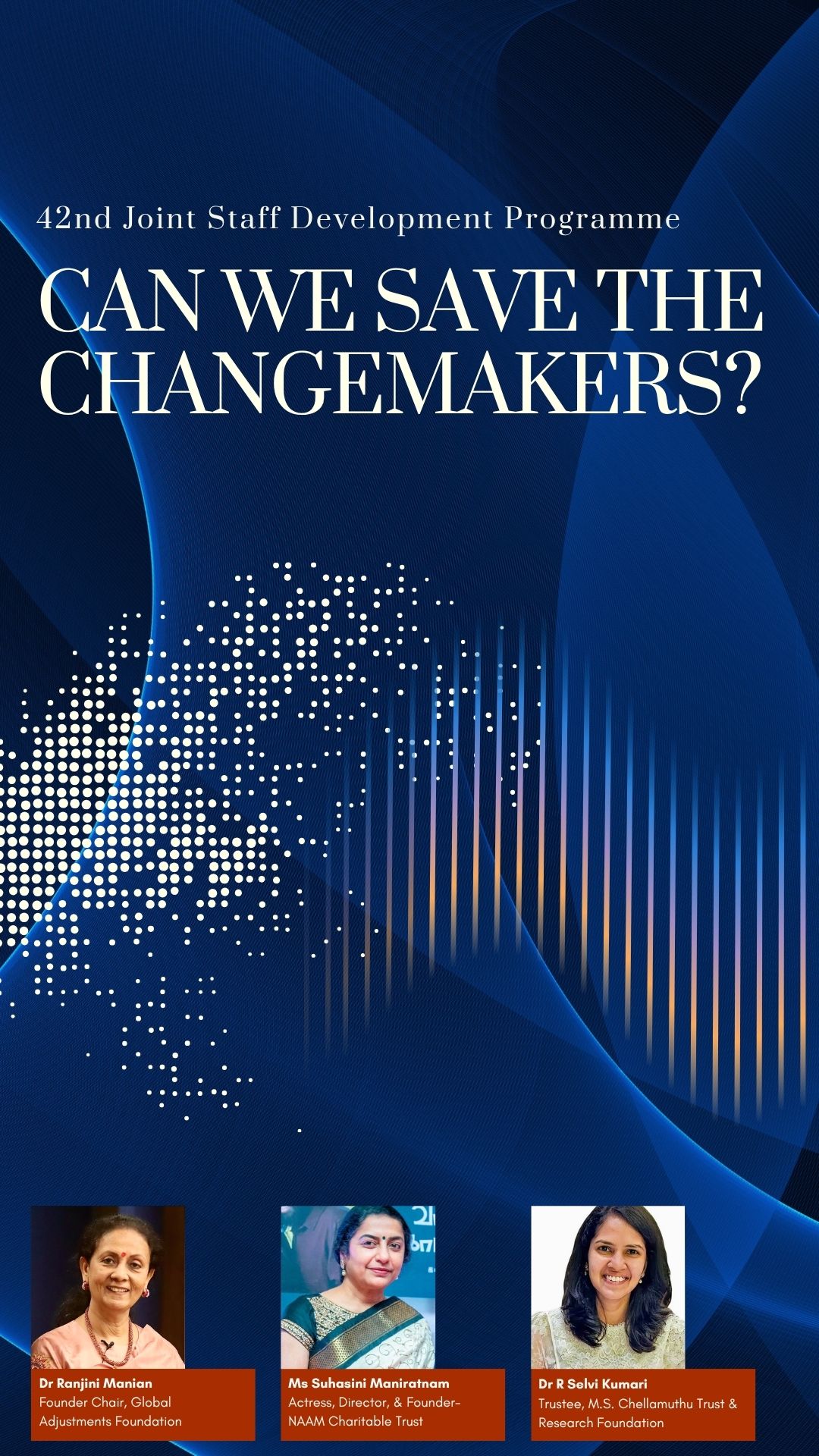
MMA was privileged to organise the 42nd Joint Staff Development Programme 2026, jointly with Konrad-Adenauer-Stiftung (KAS), from 22–24 August 2026 at The Carlton, Kodaikanal, on the theme “Leading Change in a Decade of Disruption: Strengthening Civil Society for India@2047.”
The programme brought together over 70 participants from KAS partner organisations across India, creating a vibrant platform for dialogue, reflection and peer learning. A distinguished group of speakers and practitioners shared valuable perspectives on the challenges and opportunities confronting civil society in an era defined by technological disruption, geopolitical uncertainty, climate risks, social transition and rapidly changing institutional expectations.
As India advances towards India@2047, civil society organisations will have an increasingly important role in strengthening communities, promoting inclusion, deepening democratic participation and creating sustainable models of social impact. The need, therefore, is for institutions that are not only committed to purpose, but are also strategically agile, ethically grounded, technologically aware and resilient in the face of change.
JSDP 2026 sought to strengthen precisely these capabilities by addressing issues ranging from governance, leadership and communication to technology, talent development, partnerships, mental well-being and organisational sustainability.
In this issue of Business Mandate, we are delighted to present highlights from two particularly insightful sessions with embedded video: “Civil Society in India@2047: The Road Ahead” and “Well-being, Burnout & Mental Resilience in the Development Sector.” Both conversations offer valuable lessons for leaders navigating the increasingly complex development landscape.
Strong institutions build strong communities. And strong civil society institutions are indispensable to realising the promise of India@2047.
70 Skills. 24 Hours. One Extraordinary Learning Experience.
As MMA celebrates its Platinum Jubilee, we are marking this landmark year not only by looking back with pride, but also by creating new platforms that prepare our members for the future.
One such special initiative is the 24-Hour Non-Stop Management Skills Conclave, showcasing 70 Essential Management Skills for Success. The programme will commence on 24 September 2026 and continue non-stop for 24 hours, concluding on 25 September 2026.
In today’s rapidly changing world, functional expertise alone is no longer enough. Professionals increasingly need agility, communication, strategic thinking, people leadership, digital orientation, sound decision-making and, above all, the ability to continuously learn and reinvent themselves. With this in mind, MMA has carefully curated 70 management and self-development skills, to be presented by accomplished facilitators with rich practical experience.
The initiative also revives a memorable MMA milestone. In 2012, when MMA completed 56 years, we successfully organised a pioneering 24-hour programme covering 56 management and self-development topics. In our 70th year, we are taking that spirit of learning to an even greater scale.
70 Skills. 24 Hours. Non-Stop.
The entire programme will also be broadcast live through MMA’s digital platforms, enabling a much wider audience to participate in this unique learning experience.
As a special Platinum Jubilee initiative, participation is being offered to MMA members without any registration fee, subject to availability and confirmation.
More than an event, this is MMA’s reaffirmation of a simple but enduring belief: in a world of constant change, continuous learning remains the most powerful competitive advantage.
I look forward to welcoming you to this extraordinary learning marathon.
Join us in person. Watch it live. Keep learning. Keep growing.
Understand Gen Z: Listening to the Voice of Young India
India’s Gen Z is coming of age with a distinctly different worldview. For many young Indians, freedom today extends beyond political independence—it is also about the freedom to think, create, choose, question and express themselves without fear or labels.
As their influence across workplaces, markets and society grows, it is important that we understand this generation beyond convenient stereotypes. India’s ability to fully realise its demographic dividend will depend significantly on how effectively our institutions engage with their aspirations and create opportunities for them to flourish.
The challenge is to help young Indians combine technological capability with scientific temper, entrepreneurial ambition with social responsibility, a digital-first global outlook with cultural confidence, and individual expression with a commitment to nation-building.
As Gen Z begins to assume greater professional and societal responsibilities, their energy and creativity must be complemented by wisdom, character, resilience and purpose. Equally, institutions must be willing to listen, adapt and create environments in which young people have both the confidence to experiment and the opportunity to contribute.
In this context, I am delighted to share that MMA has undertaken a comprehensive survey involving over 200 Gen Z participants to better understand their aspirations, realities and expectations. The findings provide interesting insights into what motivates Young India and what institutions must do differently to meaningfully engage with them.
Building on these insights, MMA is developing an exclusive “Young India” initiative, designed around the aspirations and expectations of this generation and the capabilities they will require to succeed in the 21st century.
To benefit from our demographic dividend, we must do more than prepare Gen Z for the future—we must also be prepared to listen to the future they want to create.
Food Claims: Read Beyond the Label
The Food Safety and Standards Authority of India (FSSAI) is tightening scrutiny over health and nutritional claims made by food manufacturers—an important step towards ensuring that promotional language is supported by credible evidence and does not mislead consumers.
This assumes particular significance at a time when India is confronting growing concerns relating to obesity, unhealthy dietary habits and non-communicable diseases. Attractive phrases such as “healthy,” “natural,” “high protein,” “low fat,” or similar claims can strongly influence purchasing decisions. But consumers must remember that a claim on a food packet is a claim—not necessarily a guarantee of better health.
For manufacturers and marketers, the message is equally important: communication must be responsible, transparent and capable of substantiation. The need is to strike an optimal balance between legitimate product promotion and the consumer’s right to accurate information.
As consumers, we need to look beyond attractive packaging, read labels carefully, understand nutritional information and make informed choices rather than being guided solely by marketing claims.
Creating an informed movement towards responsible consumption and responsible communication should be our collective aim. Better awareness, better choices and greater accountability can contribute meaningfully to a healthier society.
A Himalayan Tragedy: A Warning We Cannot Ignore
The devastating tragedy in the Himalayas is yet another sobering reminder of the growing vulnerability of one of the world’s most fragile ecosystems. Preliminary assessments indicate that a massive high-altitude collapse involving rock and glacial ice triggered the catastrophic flash floods in Nepal, causing enormous loss of lives and widespread destruction.
While the precise causes continue to be studied, rising temperatures, retreating glaciers and changing mountain conditions are increasing concerns over the stability of the Himalayan region. The tragedy should compel us to better appreciate the complex links between climate change, glacial instability, infrastructure development, tourism and the lives and livelihoods of millions who depend on this ecosystem.
India’s immediate response in extending support to Nepal in its hour of crisis is deeply commendable and reflects the enduring friendship between the two neighbours.
Beyond relief and rehabilitation, however, this calamity carries an important message: preparedness must keep pace with growing climate and geological risks. Better monitoring, early-warning systems, resilient infrastructure and stronger regional cooperation are imperative if similar disasters are to be prevented from turning into tragedies of such enormous human consequence.
The Himalayas are warning us. We must listen—and act before the next disaster strikes.
As always, we would be happy to hear your views, comments and suggestions.
Happy Reading!!