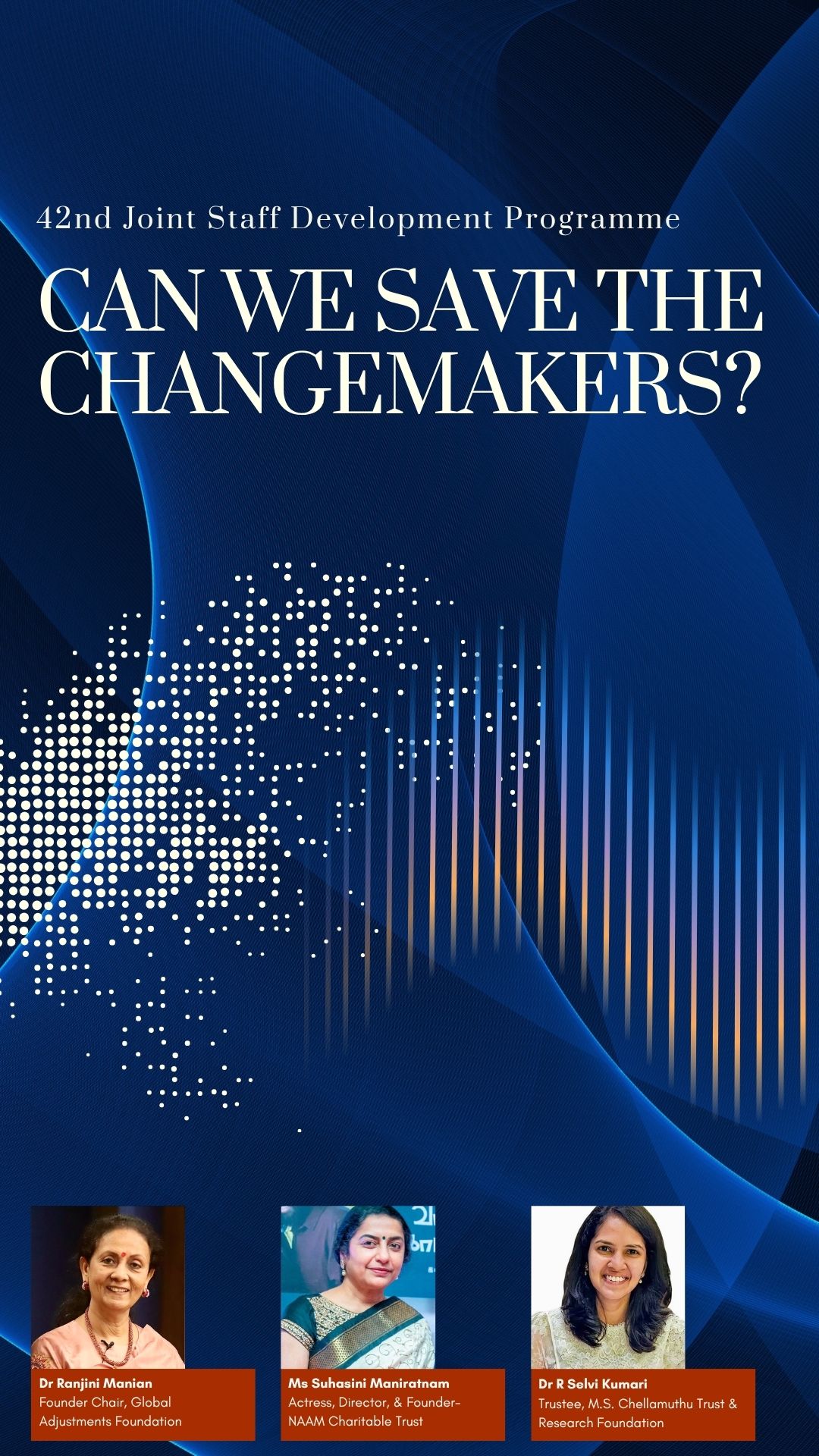
From mindful breathing to setting boundaries—three women leaders share hard-won lessons on self-care for India’s civil society warriors.
Dr Ranjini Manian
Founder Chair, Global Adjustments Foundation
Thank you, MMA, for bringing us to Kodaikanal, a second home for me and for my dear friend Suhasini — we both have houses here, so saying yes to this venue was easy. I want to thank my friend of forty years, my philosopher and guide, Suhasini Maniratnam. We’ve lived next door to each other for decades, and discovered we were building the same thing from different doors: women’s empowerment. She runs NAAM Charitable Trust. I run Global Adjustments Foundation, which we call Champion Woman — we work with corporates, the army, police and colleges to help women protect their work-life balance, and separately adopt top-performing girls from underprivileged schools, fund their education, and place them into careers, because “champion a woman, she will build the nation.”
We’re all here because we care deeply about people — that’s the nonprofit instinct. But the people we care for need to be able to lean on us, exactly how each of you built your organisations. What I want us to protect, going into the future, is our own inner strength — well-being, no burnout, resilience. So let me ask directly, Hasini and Dr Selvi: how do you care for yourself? Not from behind the people you serve, not from the side — from the centre.
I use a lot of mindfulness in my workshops, so let me offer one here. Settle into your chair, head, neck and back in a straight line, eyes gently closed. Visualise the faces of the people you serve, then bring in your own family, and smile inwardly, knowing you hold this circle of love and purpose. Put your attention on your breath — breathing in, I know I am breathing in; breathing out, I know I am breathing out. The breath is the best anchor I have to know I am alive. In service to a larger purpose, we also have to look after the mind that sits on our own shoulder, the monkey mind, and learn to guide it. One more small practice: write down one thing you’re grateful for that happened today, at work or at home.
I’ll leave you with an acronym to carry home — JSDP. J is to Journal your gratitude every day. S is to Slow down — it’s when we’re most sped up, giving twenty percent of our attention to five things at once, that we burn out fastest; give a hundred percent to one task at a time and you’ll go further, faster. D is to Deepen your breath, so you stay aware of who you are. And P is about People — placing yourself in the middle of that circle, not at its edge.
Ms Suhasini Maniratnam
Actress, Director, Screenwriter, Producer & Founder-Managing Trustee, NAAM Charitable Trust
How do you follow that? Ranjini taught me well. For my own self-care, it’s my morning yoga, my morning walk, and my Bharatanatyam — my “me time.” I’ve been working continuously since April, so I’m giving the whole of September to myself, not to my family, not even to the NGO. You have to take that sabbatical from whatever you’re running around doing.
I didn’t come to this work through training. I come from a small town, a joint family, and after marriage I enrolled for a sociology degree. An uncle asked why I needed a degree when I was “already like a doctor” compared to others, so I gave it up — but the instinct to study people was already there. My real education began when the actress Revathi asked me to help raise funds to bring home domestic workers stranded in Kuwait — women abused and cheated by agents, who fled barefoot at three in the morning to the Indian embassy with nothing, and who, under local law, could only leave the country after time in a central jail. In the fourth year, I got a call: sixty women were being flown to Chennai and I had two days to prepare. My friend Ranjini — then still in the corporate world — and I bought sixty small comforts and went to the airport not knowing what to expect. Most of the women couldn’t even finish half an idli at breakfast — their stomachs had shrunk in prison.
That pushed me into community work, and I trained for it properly through a gruelling leadership programme, alongside a film career, a small child and a “demanding” husband. At the end of that course you had to choose a public project. I chose the hardest of my five ideas: a train ambulance for patients travelling home from Chennai’s hospitals. It failed completely — the railways said they carried passengers, not patients. My coach said I’d have ended up doing my real project anyway: caring for single women, widows, and Dalit and Muslim women alone in society. That failure told me my actual passion, and NAAM Charitable Trust began.
I’ll give you failures, not successes, because that’s where the learning is. Early on, registering a young widow into our programme, I ran through my questions mechanically — name, age, house, children — until I asked how long she’d been widowed. Seven days. I put my pencil down; I had been so clinical I’d missed the person in front of me entirely. Another time, we took sixty women for cancer screening, focused entirely on logistics, and eight were called back for further tests. They were furious with me — their peaceful lives had been upended, and my own housekeeper, a widow among them, wanted to quit working for me altogether. My sister, a doctor, told me plainly: prepare people before a test like that, not just after. I even failed with one of our proudest successes — a first-generation engineering graduate, married off at his mother’s insistence into a wedding I ended up funding, only for the marriage to collapse within six months into a legal case. Sixteen years in, fifty-one first-generation graduates on, getting volunteers to simply show up remains a daily battle. I’m still learning, which is partly why I’m here to learn from you too.
On funding — it has to keep shifting; there’s no permanent single source. I stay out of CSR because our giving is case by case, one lakh for one person, five hundred rupees for another, not something a donor’s paperwork can accommodate. Instead, friends have carried us: Shah Rukh Khan once handed me the Chennai premiere rights to two of his films so we could sell out theatres and keep the proceeds; we auction pre-loved saris from actresses and classical dancers before Deepavali, when women need them most. Lots of failure, but sixteen years in, something is clearly going right.
Dr R Selvi Kumari
Clinical Psychologist and Trustee, M.S. Chellamuthu Trust & Research Foundation
The bar has been set very high by both Dr Ranjini and Mrs Suhasini — as a psychologist listening to them, I found more wisdom sitting beside me than in most textbooks. Everything Suhasini says she “didn’t know how to do” was, in fact, care straight from the heart — there’s no science that teaches that better. My own masters in counselling felt airtight until I sat in front of my first real patient and realised theory doesn’t prepare you the way lived experience does. Every failure she described is exactly what builds resilience — the refusal to give up after being knocked down.
I come from M.S. Chellamuthu Trust and Research Foundation, founded three decades ago by Dr C Ramasubramanian out of a story of personal pain, like most NGOs. We work across children, the elderly, adults and the homeless as a one-stop mental health service — awareness, treatment, rehabilitation, vocational training, suicide prevention, de-addiction, rescue of homeless persons with mental illness, and community camps. I’m glad well-being finally has a seat at this table; not long ago it wasn’t part of any conference agenda. When NGOs go to donors, the first question is always return on investment, then long-term impact — but the real determinant of sustainability is whether you can sustain your change-makers. The data is sobering: sixty-five to seventy-five percent of professionals in the social work sector are experiencing burnout — no longer an individual problem, but an operational threat to mission delivery and talent retention.
Burnout looks different here than in the corporate world. Corporate motivation is largely financial and career-driven, with at least some boundary around work hours; ours is mission-driven, and boundaries barely exist. I call it a “passion tax” — the guilt of stepping away from something human. I pay it myself: when I end a session late to collect my daughter from school, and she has to run extra laps at tennis practice because I couldn’t shut down on time, that’s professional guilt layered onto maternal guilt. Emotional exposure compounds it, too — nothing prepares you for sixty women landing at an airport with nothing, the way Suhasini described.
In our quick poll of this room, the top drivers of burnout came back almost evenly split: difficulty saying no, guilt over stepping away, and chronic task overload — too much on the plate, too little operational support. Burnout doesn’t arrive overnight; it’s a slow parasite, catchable early, like a traffic signal moving from green to amber to red. The earliest, most useful moment to act is in the green zone, on nothing more than a silent internal signal — something feels off, long before anyone else notices. Left unchecked, warning signs multiply: emotional exhaustion, hopelessness, a “saviour complex,” presenteeism, boundary erosion, rising team tension, and organisationally, high turnover and normalised stress.
Resilience has to be built at every level. Individually: boundary setting, and the mindfulness and gratitude practice Dr Ranjini just walked us through. At the team level: normalise vulnerability — when someone says they’re overloaded, don’t stigmatise it; realign the work, build in peer debriefing after difficult field visits. At the organisational level: institutionalise well-being with mental health days, and budget adequately for staff in every grant application, because chronic understaffing alone manufactures burnout. A 2025 not-for-profit funding survey backs this: well-being practices lift retention and morale, cut burnout risk, and improve programme quality from around sixty-five to eighty-five percent. If you want to sustain your mission, sustain your change-makers. Worker well-being is community well-being — you cannot pour from an empty cup, or heal communities with an exhausted workforce. Well-being has to be a right, not a priority.