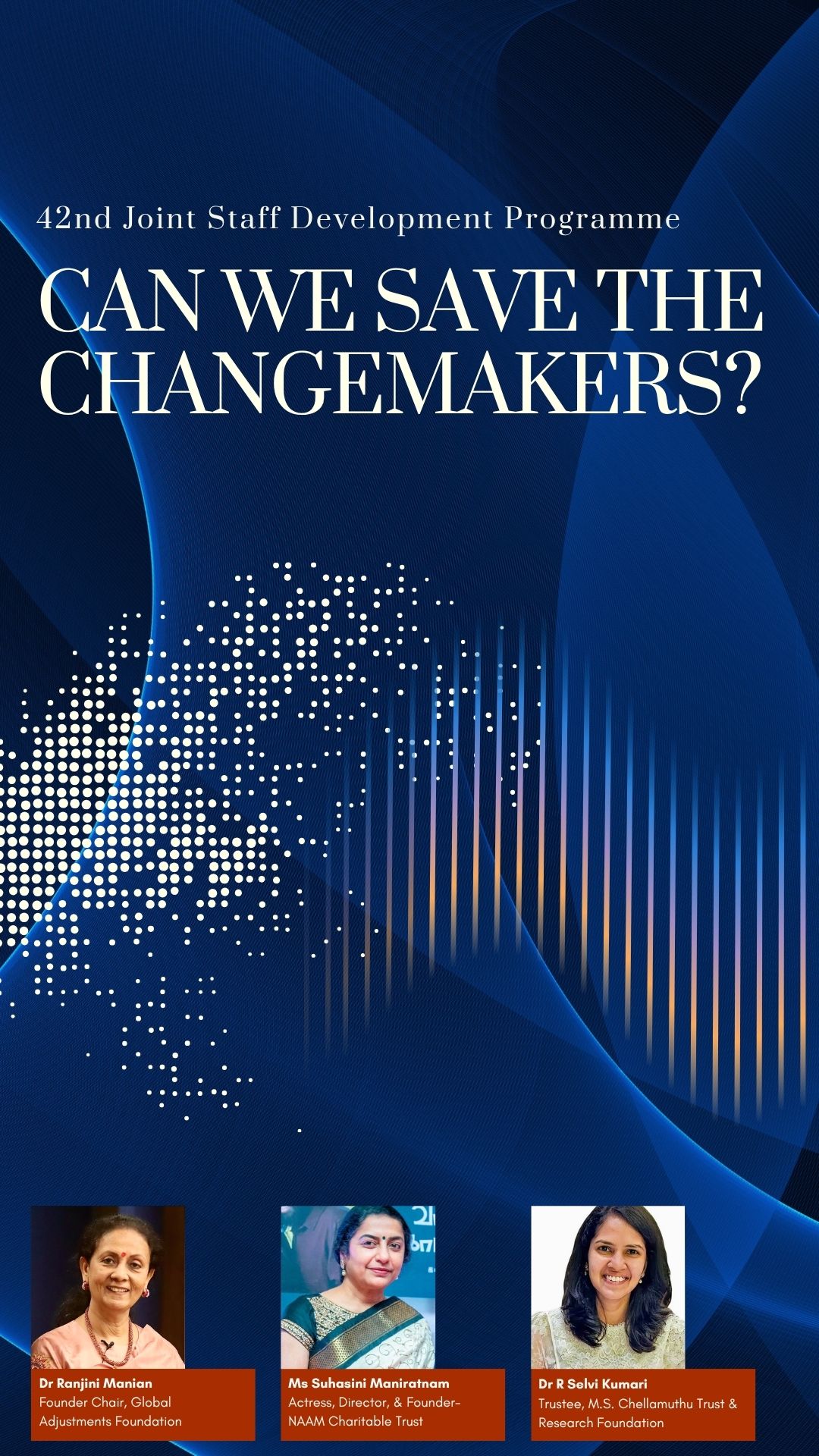
How does India move from generics to global drug innovation? Three biopharma leaders discuss the leadership, science, and capital required.

Dr Bala Subramanian
Co-Founder & COO, Bugworks Research India Pvt. Ltd | Former Senior Director, AstraZeneca Global Infection Innovative Medicines
India is called the pharmacy of the world, and we have earned that title — the Patent Act of the 1970s built a generics industry that now delivers affordable medicines to a huge share of humanity. But too much success in one area breeds a little complacency in another. In sixty-odd years of pharma in this country, truly innovative medicines have been a rarity; the first novel drug from India to be registered with the US FDA happened only this year. I come from a big-pharma background for most of my career, but the last decade in a startup environment has convinced me that innovation thrives far better in a small, focused team than inside a very large organisation — that’s my personal bias, and I’ll own it. What gives me real optimism is how much core capability India has built: clinical depth, and now the AI/ML wave transforming discovery engines, all of it fuelled by a sustained government push over the last two decades — grants, public funding, and a regulatory climate now harmonising with the US FDA and EMA so that we can talk about full New Drug Applications, not just abbreviated ones. I joined AstraZeneca in the mid-90s, a centre built by Dr Anand Kumar specifically to bring returning Indian scientists home.
When AstraZeneca exited R&D a decade later, that talent pool seeded twenty or thirty companies — Bugworks among them. We started in 2013, four of us around a table at C-CAMP, and our first business plan was scribbled on a scrap of paper. Welcome Trust funding got us going; BIRAC gave us space and seed money; and in 2016 we won a CARB-X grant as the only awardee outside North America and Western Europe — a genuine global validation. Our first cheque, though, came from an angel investor with no background in science at all, who told my co-founder over tea, “I have land banks, I make thirty times. I’m not looking for that. What I want is impact.” That is the kind of patience this business demands: the drug Zaynich, India’s first US FDA-approved innovative drug, took thirty years and outlived several generations of the scientists who worked on it. We chose antibiotics because every major pharma company had abandoned the field — a seven-day cure cannot compete with a lifelong prescription — and in 2020 we added oncology because a friend’s cancer treatment cost him over a crore in a single year. We have since raised more than sixty million dollars, and today a WHO pipeline review shows only four candidate drugs worldwide targeting all critical bacterial pathogens — ours is the only one that is both intravenous and oral and genuinely novel. None of this happens without patient capital, and India still lags here — China outspends us roughly twenty-five times over in R&D, and our own VC community, quite reasonably, prefers three-to-five-year returns from e-commerce and fintech over a twenty-year pharma bet. The late Mr Ratan Tata put it to us plainly: this is a binary game — there’s no reward for a ninety-percent-successful drug. What gives me hope now is the new RDI fund, roughly a lakh crore disbursed over six years, with biopharma as one of its priority sectors, matching every rupee a company raises itself. Bringing a drug from concept to launch is like a ten-thousand-piece puzzle: get one piece wrong and you fall down, which is why AI/ML matters so much now — it can shrink ten thousand potential failures down to ten. It takes more resilience to sustain this journey than to start it. I hope one day a successor of mine gets to stand here and tell you about a drug that came out of Bugworks.

Mr Gopala K Dasika, BVSc, PhD
Advisor & Biopharma Consultant | Biopharmaceutical Leader
Bala and I go back to our PhD days together, though he worked on the discovery side and I trained as a veterinarian before completing a PhD in Molecular Virology and Oncology. My own path took a turn I never quite planned: I wanted to build gene therapies for cancer, and set out to do exactly that when I moved back to India. Over the twenty-five years since, working with companies both globally and in India, I found myself pulled instead into biologics and biosimilars — a discipline that is really about carrying a product the rest of the way, from where Bala’s world leaves off to the patient. We publish beautifully in Nature, Science, Cell, yet very few of those discoveries ever become drugs, and the reasons go beyond the science itself. Scientists are trained to be rigorous problem-solvers, but getting a medicine to a patient takes a village: different functions, cultures, and systems across an organisation, sometimes thousands of people, all needing to align around one mission. That is a leadership problem as much as a scientific one. Money has been part of our historic weakness too — we simply did not have a VC culture that understood this business — but that is changing. In biologics specifically, we have built enormous capability over the last twenty-five years; I was fortunate to work at Biocon and watch that capability compound. My honest belief is that the next ten years will show far more progress in Indian drug discovery and development than the twenty-five years before it.

Dr J M Packiaraj
Chief Scientific Officer, Hibrow Health Care Pvt Ltd
Thank you to MMA for arranging this wonderful symposium, and thank you, Dr Bala, for a presentation that I hope was an eye-opener for everyone — you have laid it out perfectly: an innovation starts with him, moves through clinical trials, and eventually lands with people like me for formulation development. I began my career in the early 2000s at Orchid Chemicals and Pharmaceuticals as a formulator for new chemical entities. The hardest part of that job was always the same: an innovative compound arrives with rich chemistry data but almost nothing on its physicochemical properties — partition coefficient, solubility, its BCS classification — all the things a formulator needs before designing intravenous or intraperitoneal dosing for the first animal trials, bypassing first-pass metabolism to see how the drug truly behaves in systemic circulation. I spent over three years there across a range of NCE formulations, and it shaped everything that came after. Today I lead formulation at Hibrow Health Care, a generic company we started in 2018. In five years, through the pandemic and everything it threw at us, we built a completely greenfield facility, developed more than twenty products for the US FDA, secured approval on twelve of them, cleared two US FDA audits without a single 483, and in the last six months began commercial sales into the US market ourselves. So, Dr Bala — if you ever need formulation support for your NCEs, come to Hibrow; we have the talent pool to help across both formulation development and clinical trial formulations. Thank you, MMA, for this wonderful opportunity.
Q&A
From scientific discovery to patient impact, what are the most critical stages where strong leadership can make the difference between an idea succeeding or failing?
Dr Bala Subramanian
The critical stage is any fork in the road — the moment you weigh the chances against the risks you’re carrying forward. That takes real leadership, because sometimes the decision is harsh: kill the project. We say fail early, fail cheap, and that holds all along the value chain — the earlier you fail, the cheaper it is. But making that call is the hardest part of the job, because people have put their blood and guts into that concept, and killing it hurts them.
Healthcare innovation requires scientific rigor but also speed, affordability, and operational efficiency. How can leaders balance these competing priorities?
Mr Gopala K Dasika
This is the leadership challenge I was pointing to earlier. Science usually gets taken care of; what doesn’t is designing with the end label in mind before you even set your strategy — building cost of goods into the process from the front end, not discovering the problem afterward. This matters enormously in biologics, where medicines are expensive and margins are thin. Sometimes that means killing a program early rather than carrying it through clinical development only to end up with something approved but unprofitable. In the biosimilar world especially, where competition is intense, the whole point is building a product that will actually be affordable for patients — and that discipline has to be designed in from day one.
What are the biggest challenges in taking an innovation successfully from the laboratory to commercial-scale production?
Dr J M Packiaraj
This comes up in nearly every project. Your R&D batch — whether it’s a tablet, capsule, or injectable — might be a thousand units, but commercial batches run to ten or twenty lakh units or more, and the real challenge is transferring that technology cleanly to true commercial scale. We address this in two ways. First, the formulator who developed the product from scratch has to stay responsible for its scale-up — hand it to someone new partway through and failures creep in, because that person doesn’t carry the product’s full history. Second, you cannot jump straight from a small successful batch to commercial scale, even if the stability data looks perfect. You need an intermediate scale-up or process-optimisation batch, run in the same commercial shop, studying blend quality, hardness, hopper level, and every other parameter to identify your critical quality and critical material attributes. Get that right during scale-up, and you can transfer the product from R&D to the shop floor successfully.